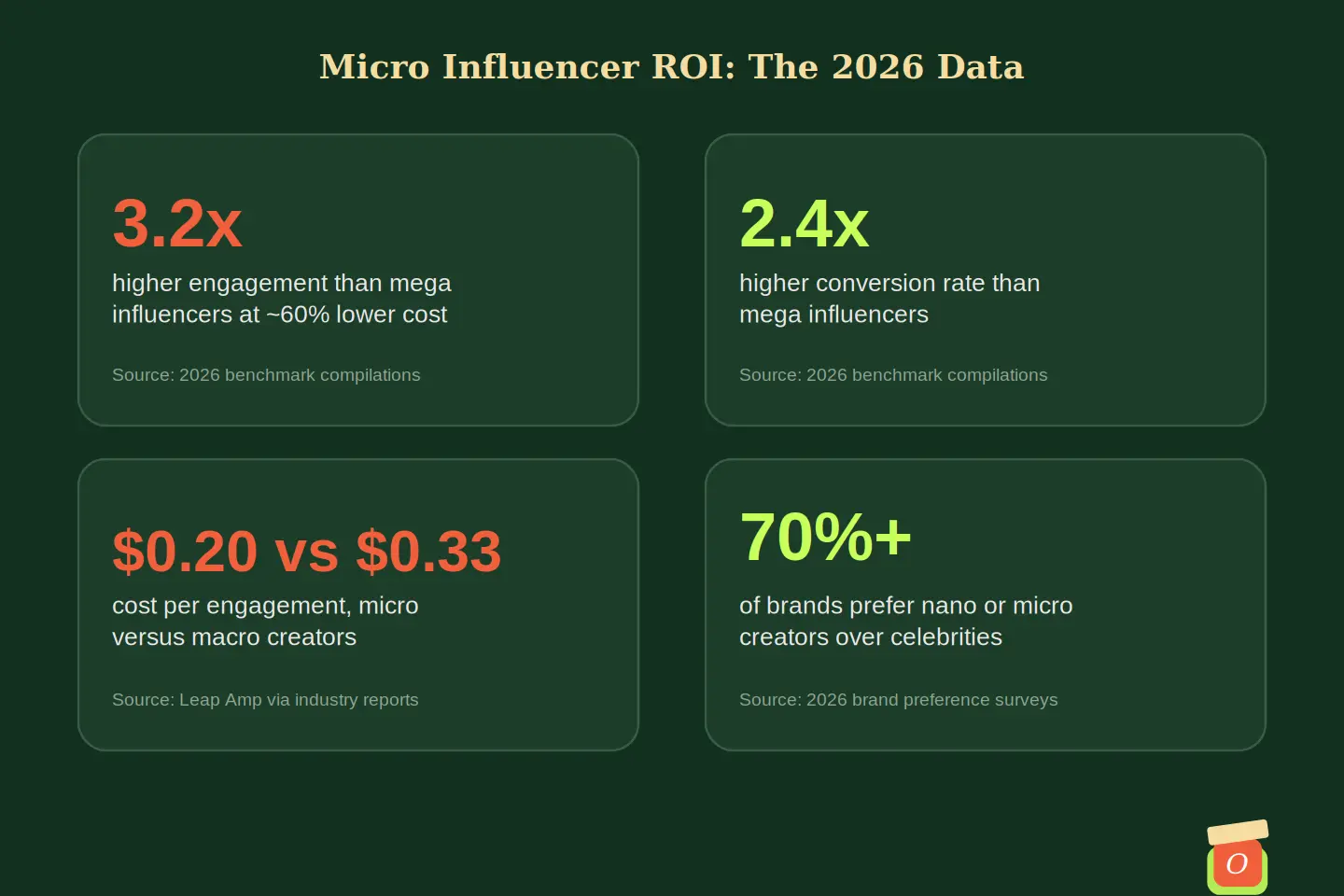
Micro-influencers return an average of $7.14 for every $1 brands spend, the highest of any creator tier in 2026 benchmark data, while mega-influencers return about $3.42. That gap surprises many marketing teams, who still assume a bigger follower count must mean a bigger result. It also explains why so many budgets are quietly shifting toward smaller names, even at brands that once built every launch around a celebrity. The numbers say otherwise: micro creators deliver roughly 3.2 times the engagement of mega-influencers at about 60 percent lower cost per post.
Understanding why micro influencers deliver better ROI helps you stop spreading budget across a handful of expensive names and start building a roster of smaller, closer-knit audiences. This guide covers the engagement, cost, and conversion data behind the pattern, the situations where larger creators still make sense, and how Brand-O-fluence helps you find verified creators with 5K, 10K, 20K, and 50K followers in minutes. If you want the broader business case for creator partnerships first, start with our guide on the benefits of influencer marketing for brands.
Table of Contents
- Why Micro Influencers Deliver Better ROI: The Core Data
- Higher Engagement From Smaller, Closer Audiences
- Lower Costs and Better Efficiency
- Where Macro Influencers Still Win
- How to Build a Micro Influencer Strategy
- How Brand-O-fluence Helps Brands Find Micro Creators
- Step-by-Step: Launching Your First Micro Influencer Campaign
- Frequently Asked Questions About Why Micro Influencers Deliver Better ROI
Why Micro Influencers Deliver Better ROI: The Core Data
The ROI advantage of smaller creators shows up across engagement, cost, and conversion at the same time. That consistency is what makes the pattern worth building a strategy around.
What Counts as a Micro Influencer
Most benchmark sources place micro-influencers between 10,000 and 100,000 followers, with nano creators below 10,000. Definitions vary by report, and some Indian agencies treat 50,000 as the upper limit. For planning purposes, think of anyone between roughly 5K and 100K followers as the sweet spot where audiences are still personal but large enough to move real volume.
The ROI Numbers by Tier
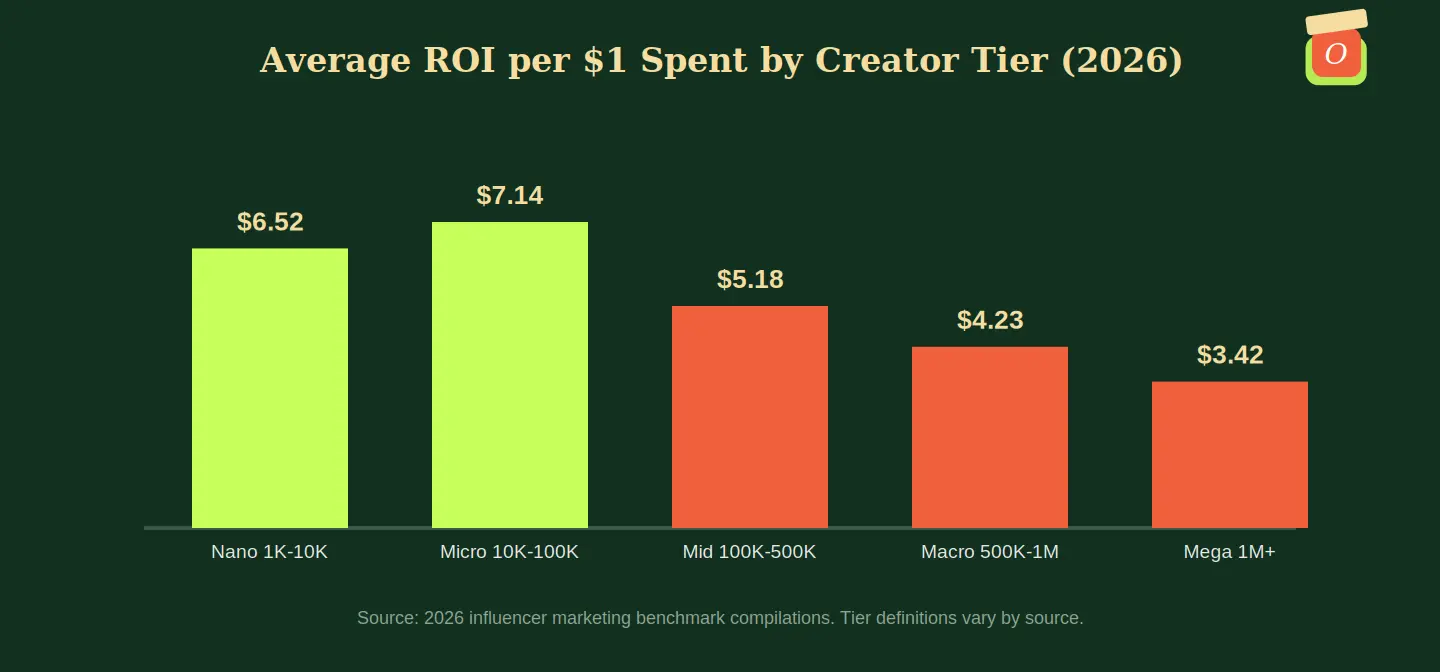
Benchmark compilations for 2026 put average return per dollar at $6.52 for nano creators and $7.14 for micro creators. Mid-tier creators return about $5.18, macro creators $4.23, and mega creators $3.42. The overall average across all tiers and platforms sits near $5.78, which means micro creators beat the market average by about 24 percent.
Why Reach Alone Misleads
A macro creator with 800,000 followers may reach 100,000 people per post, but many of those viewers have no particular interest in your category. A micro creator reaching 8,000 people who follow them for a specific niche is often a better use of the same budget. Reach tells you how many people saw a post, while return tells you what those views were worth.
Platform matters too. On TikTok, one 2026 compilation puts micro creators with 10,000 to 50,000 followers at about 8.7 percent engagement, while nano creators reach roughly 10.3 percent. On YouTube, micro creators averaged about 5.2 percent against 2.8 percent for macro creators. The shape is the same everywhere: as audiences grow, attention per follower tends to fall.
Higher Engagement From Smaller, Closer Audiences
Engagement is where the micro advantage shows up first, and it is also the clearest explanation for the stronger returns that follow.
Engagement Rates by Tier
On Instagram, one widely cited benchmark shows micro-influencers averaging 3.86 percent engagement against 1.21 percent for mega-influencers. Nano creators in the same data average 4.84 percent. Conversion rates follow the same shape, at 2.41 percent for nano, 2.18 percent for micro, and 0.91 percent for mega creators.
Trust and Community
Smaller creators usually know many of their followers by name, reply to comments, and recommend products they actually use. That closeness is why audiences treat a micro creator’s recommendation like advice from a friend. It also explains why roughly 70 percent of brands now say they prefer nano or micro creators over celebrities. When a creator with 15,000 followers shares a skincare routine, the comments often turn into real questions about shade, price, and where to buy. That kind of conversation is far harder to generate under a celebrity post, where most comments are reactions to the person rather than the product.
A Note on Benchmark Differences
Not every source shows the same gap. Influencer Marketing Hub, for example, reports a much narrower difference between micro and macro engagement, at about 2.15 percent versus 2.05 percent. Tier definitions, platforms, and niches all change the numbers. The direction is consistent across sources, so use these figures as a guide and confirm real engagement for every creator you consider.
Lower Costs and Better Efficiency
Better engagement would matter less if it cost more. In practice, smaller creators charge far less, which compounds the return.
Cost per Post and per Engagement
Industry data shows micro creators charging roughly 60 percent less per post than macro creators. Cost per engagement tells a similar story, at about $0.20 for micro creators against $0.33 for macro creators. In India, typical estimates run from about 3,000 to 8,000 rupees per Reel for nano creators and 8,000 to 25,000 rupees for micro creators. Our guide on the future of influencer marketing in India breaks down these tiers in more detail.
Spreading Budget Across Many Voices
One macro placement puts your entire budget behind a single creator and a single audience. Ten micro placements for the same money give you ten different audiences, ten pieces of content, and ten chances to find a message that works. If one creator underperforms, the others still carry the campaign.
Here is a simple example. Suppose you have 5 lakh rupees to spend. One macro creator at that price delivers a single post to a broad, mixed audience. The same budget at an average of 25,000 rupees per micro creator funds about twenty partnerships. Even if five of those perform poorly, fifteen are still working, and you have clear data on which creators and messages earn their fee.
More Content for Every Rupee
Every micro creator produces original content you can often reuse across your own channels, subject to usage rights in the contract. A campaign with twelve creators gives you twelve distinct testimonials, tutorials, or reviews. That library keeps paying off long after the campaign ends, since good creator content can feed product pages, email campaigns, and paid ads once usage rights are cleared in writing.
Where Macro Influencers Still Win
Micro creators are not the right answer to every problem. Being honest about the tradeoffs makes your plan stronger.
Mass Awareness on a Deadline
When you need to reach millions of people quickly, such as a major product launch or a national campaign, macro and celebrity creators deliver reach that dozens of micro creators would struggle to match. This is the top of the funnel, where impressions matter more than conversion efficiency. If your product is already well known and you simply need to remind a huge audience it exists, paying for scale can make sense even when each individual interaction costs more.
Brand Prestige
Some brands benefit from the credibility of an established public figure, especially in premium categories. A celebrity endorsement can signal scale and legitimacy in a way a group of smaller creators cannot. The cost is higher, and the return per rupee is usually lower. Before paying that premium, ask whether the prestige will change a buying decision, or whether a handful of trusted niche voices would do the same job for far less.
A Blended Approach
Many strong programs use both. A common pattern is putting most of the budget into micro and nano creators for conversion and trust, with a smaller share on one or two larger names for reach. The right ratio depends on whether your goal is awareness, engagement, or sales. Review results after each campaign and move the split toward whichever tier actually returned the most, rather than relying on habit or assumptions about what a launch should look like.
How to Build a Micro Influencer Strategy
A micro strategy works best when it is deliberate. Choosing creators by size alone misses the point.
Match Tier to Goal
Nano creators between 5K and 10K work well for hyperlocal trust and tight budgets. Creators around 20K to 50K suit category launches where you want more reach without losing closeness. Define your goal first, then pick the tier that fits it. A neighborhood bakery and a national skincare label should not choose creators the same way, even if both say they want micro influencers.
Verify Before You Commit
Smaller does not automatically mean authentic. Fraud exists at every tier, and mid-tier accounts showed the highest fraud rates in recent studies. Brands that skip this step often discover too late that a creator’s followers sit in another country or come from a purchased batch. Run every shortlisted creator through the checks in our guide on how to spot fake Instagram followers before you sign anything.
Score Fit, Not Just Size
Audience location, niche, content style, and past brand work matter as much as follower count. Our guide on how to choose the perfect influencer for your brand gives you a simple scorecard for comparing candidates side by side.
How Brand-O-fluence Helps Brands Find Micro Creators
Brand-O-fluence was built so brands are not limited to celebrities. The platform makes smaller, verified creators easy to find, compare, and pay.
Search by Follower Range, Niche, and City
Brands can filter creators at 5K, 10K, 20K, and 50K follower ranges, then narrow by niche, city, platform, and engagement rate. A search that once took days of scrolling takes minutes. This is also how brands reach regional creators in Tier 2 and Tier 3 cities who rarely appear in celebrity databases. For a brand selling in Indore, Jaipur, or Coimbatore, a creator with 12,000 local followers can be worth more than a famous account whose audience is spread across the world.
Verified Analytics on Every Profile
Each profile shows engagement, audience age, gender, and top cities pulled from platform data and reviewed by a human team. You see real numbers before you send a message, which protects the ROI advantage that makes micro creators attractive in the first place.
One Workflow From Brief to Payment
Running ten small partnerships can create ten times the admin. Brand-O-fluence handles briefs, contracts, content review, and escrow-protected payouts in one place, following the same stages covered in our guide on how to run an influencer campaign.
Consider a Surat-based activewear brand that planned to spend its launch budget on two macro creators. Instead, it used Brand-O-fluence to shortlist twelve verified fitness creators between 8K and 45K followers across Gujarat, Maharashtra, and Rajasthan. Contracts and escrow were set up within a week, and all twelve published inside a three-day window. The brand reported more total saves, comments, and tracked-code orders than its previous two-macro launch, and it kept five of the twelve creators for the next campaign because their audiences converted best.
Step-by-Step: Launching Your First Micro Influencer Campaign
Follow this sequence to put the data in this guide to work. It works for a first campaign with three creators or a larger one with twenty, since the logic stays the same and only the volume changes.
- Set one clear goal: Decide whether you are chasing awareness, engagement, or sales.
- Split the budget across tiers: Put most of it into nano and micro creators, with a smaller share for reach if needed.
- Filter by niche, city, and follower range: Build a shortlist of 8 to 12 creators between 5K and 100K followers.
- Verify authenticity: Check engagement quality, audience location, and growth patterns for each candidate.
- Send a specific brief: Share messaging points, deliverables, deadlines, and disclosure rules.
- Pay through escrow: Release funds only after content is live and matches the agreement.
- Track results by creator: Use unique codes or links, then rehire the top performers.
Creator Tiers Compared
The table below summarizes how each tier typically performs, using 2026 benchmark figures. Treat the numbers as directional, since definitions vary by source.
| Tier | Followers | Engagement Rate | ROI per $1 | Best Use |
|---|---|---|---|---|
| Nano | 1K to 10K | 4.84% | $6.52 | Hyperlocal trust, tight budgets |
| Micro | 10K to 100K | 3.86% | $7.14 | Conversion and niche launches |
| Mid-tier | 100K to 500K | Varies by source | $5.18 | Broader awareness with some trust |
| Macro | 500K to 1M | 1.64% | $4.23 | Fast mass reach |
| Mega | 1M and above | 1.21% | $3.42 | Prestige and national reach |
Frequently Asked Questions About Why Micro Influencers Deliver Better ROI
Why do micro influencers get better engagement than larger creators?
Smaller creators have tighter relationships with their audiences, reply to comments, and focus on a specific niche. Followers see their recommendations as personal advice rather than advertising. As an audience grows, that closeness fades and engagement per follower usually falls. Large accounts also attract passive followers who joined for entertainment rather than recommendations.
How many followers does a micro influencer have?
Most benchmark sources define micro-influencers as having 10,000 to 100,000 followers, though some Indian agencies use 10,000 to 50,000. Nano creators sit below 10,000. Because definitions vary, focus on engagement quality and audience fit rather than a strict label.
Are micro influencers cheaper than celebrities?
Yes, by a wide margin. Industry estimates put micro creators at roughly 60 percent lower cost per post than macro creators, and in India typical Reel rates range from about 8,000 to 25,000 rupees at the micro tier. Lower prices let you work with several creators for the cost of one larger placement. Rates still vary by niche, format, and usage rights, so always confirm what a quoted fee includes before comparing offers.
Can micro influencers have fake followers too?
Yes, although fraud rates tend to be lower among nano and micro creators than mid-tier accounts. Always verify engagement quality, comment patterns, and audience location before signing. A platform with built-in verification saves most of that manual effort, and it keeps the standard consistent across every creator on your shortlist instead of depending on whoever happened to review each profile.
Should I use only micro influencers in my campaign?
Not always. If you need rapid mass awareness, adding one or two larger creators can help. Many brands put most of the budget into micro and nano creators for conversion and trust, then use a smaller share for reach. Whatever mix you choose, track results by creator so the next campaign starts from evidence instead of guesses.
Why micro influencers deliver better ROI comes down to a simple chain: closer audiences produce higher engagement, higher engagement lifts conversion, and lower fees stretch each rupee further. The benchmark data shows micro creators returning about $7.14 per dollar against $3.42 for mega creators, even though sources differ on exact gaps. Brands that build a verified roster of smaller creators spread their risk, gather more content, and learn faster than brands betting everything on one famous name. Over several campaigns, that roster becomes an asset of its own: you know which creators convert, which cities respond, and which messages are worth repeating.
If you want to put this into practice, explore Brand-O-fluence today. Filter verified creators at 5K, 10K, 20K, and 50K followers by niche and city, review real audience data, and pay safely through escrow. Start your first micro influencer campaign on Brand-O-fluence and see how far a smart budget can go.
Leave a Reply