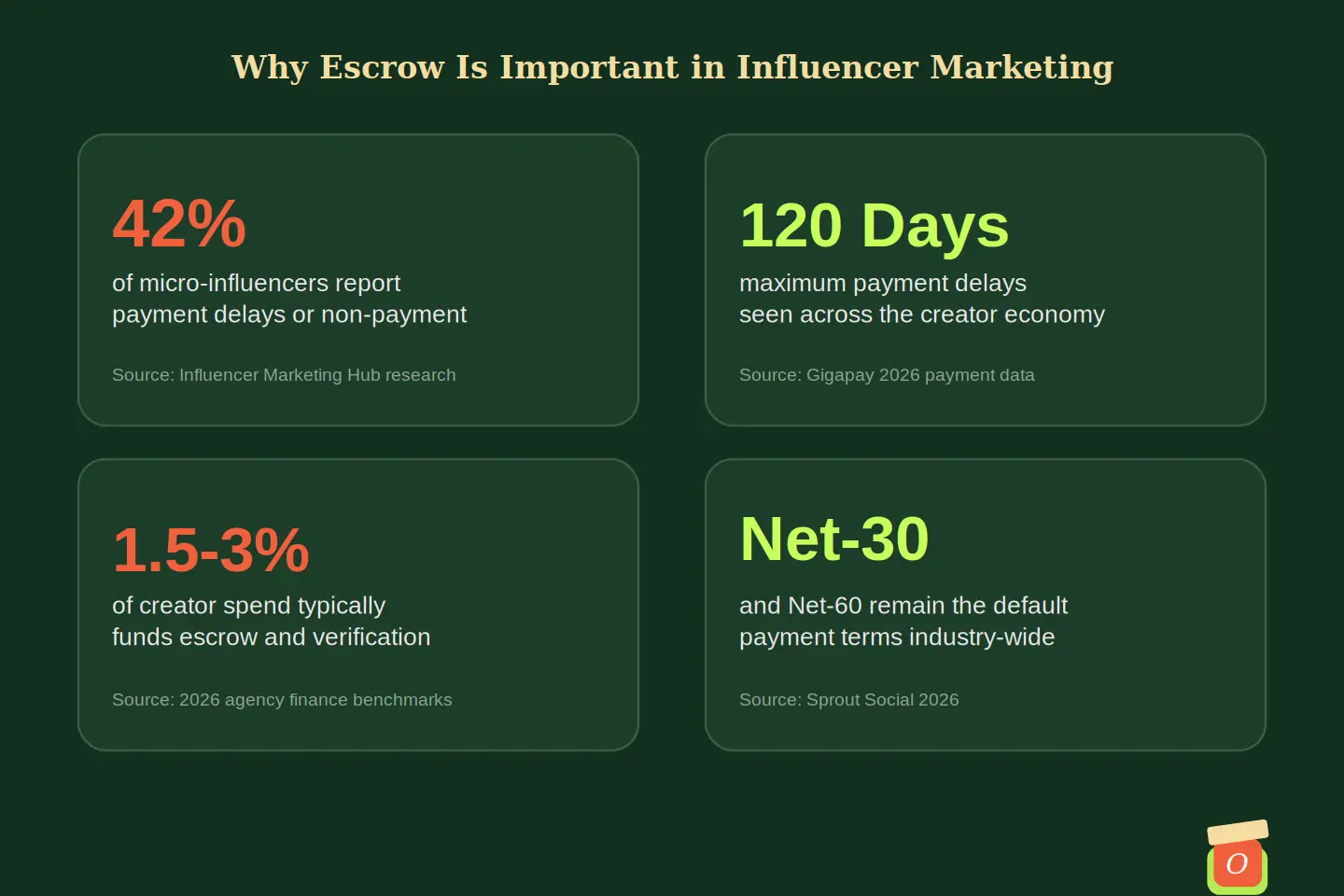
42 percent of micro-influencers report payment delays or non-payment after delivering sponsored content, and payment delays across the wider creator economy have stretched as long as 120 days in 2026. Net-30 and Net-60 remain the default terms across the industry, which means even a smooth, no-drama campaign can leave a creator waiting a month or two for money they already earned. On the brand side, the fear runs the opposite direction: pay upfront and hope the content actually shows up as promised.
Understanding why escrow is important in influencer marketing means recognizing that this is not a minor administrative detail. It is the mechanism that decides whether a brand-creator relationship runs on trust built through structure, or trust built on hoping the other side behaves. This guide breaks down how escrow actually works, what it protects on both sides of a deal, and how Brand-O-fluence builds it directly into every campaign. By the end, you should understand exactly why serious creators and brands increasingly treat escrow as a baseline requirement rather than a nice-to-have feature. It builds on one of the five prevention layers covered in our guide on how brands can avoid fake influencers, going much deeper into the payment mechanics specifically.
Table of Contents
- Why Escrow Is Important in Influencer Marketing: The Basics
- The Real Cost of Paying Influencers Without Escrow
- How Escrow Protects Brands
- How Escrow Protects Creators
- Escrow vs Traditional Payment Methods
- How Escrow Payments Work on Brand-O-fluence
- Step-by-Step: Setting Up an Escrow-Protected Campaign
- Frequently Asked Questions About Escrow in Influencer Marketing
Why Escrow Is Important in Influencer Marketing: The Basics
Escrow is a simple concept borrowed from real estate and freelance marketplaces, adapted to solve one of the oldest problems in creator partnerships: neither side wants to move first. Once you see how the mechanism actually works, it becomes obvious why so many serious platforms have built it in as a default rather than an optional extra.
How Escrow Actually Works
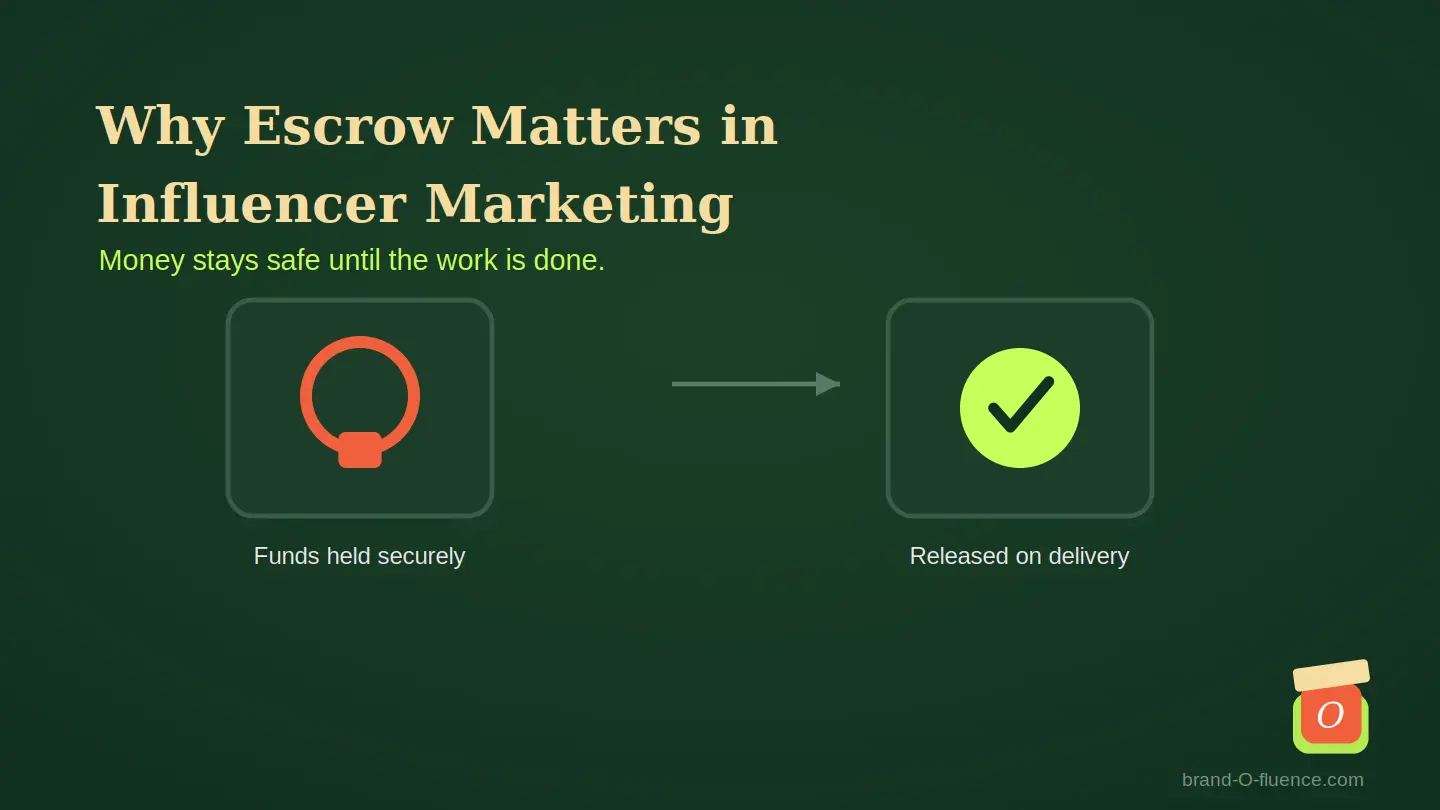
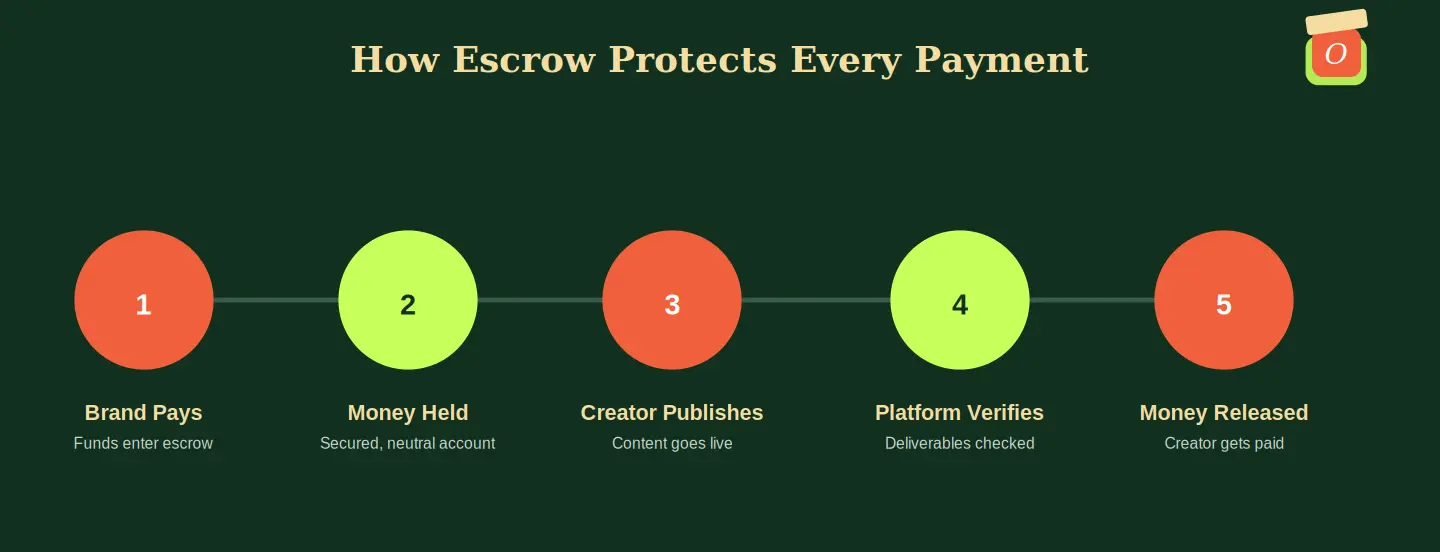
A brand deposits the agreed payment into a secure, neutral account before content production begins. The funds sit there, untouched by either party, until a defined trigger, usually confirmed publication matching agreed deliverables, releases the payment to the creator. Neither side can access the money outside of that agreed condition, which is exactly what makes the arrangement trustworthy.
The Trust Gap Escrow Was Built to Close
Without escrow, one party always has to take the financial risk first. Brands worry about paying for content that never arrives, while creators worry about producing content for a brand that never pays. Escrow removes this standoff by giving both sides a neutral party holding the money until the agreed condition is met, rather than leaving trust to chance.
Why This Matters More as Budgets Grow
A single small campaign might survive on goodwill and a good working relationship. That approach breaks down quickly once a brand is running multiple campaigns with dozens of creators across different budgets, since the odds of at least one payment dispute rise with every additional relationship added to the mix, and a single serious dispute can cost far more in time and reputation than the original payment itself.
The Real Cost of Paying Influencers Without Escrow
Skipping escrow does not remove risk. It just moves that risk entirely onto one side of the deal, and often onto both sides at different points in the process, depending on who ends up more exposed once something inevitably goes wrong.
When Brands Pay Upfront
Paying a creator in full before any content is delivered removes the creator’s incentive to prioritize the brand’s deliverable if something else comes up. Even with an honest creator, upfront payment gives a brand no real leverage if the final content misses the brief or arrives late.
When Creators Work Without Payment Guarantees
Creators who deliver content and then wait, sometimes for months, for a brand to actually pay are absorbing all the financial risk in the relationship. This is exactly the pattern behind the 42 percent of micro-influencers reporting payment delays or non-payment, and it pushes serious creators toward brands and platforms that offer real payment protection instead.
Why Both Sides Lose Without a Neutral Third Party
Without an escrow structure, every negotiation carries an implicit question neither side wants to say out loud: who has to trust the other first. That unspoken tension slows down negotiations, discourages ambitious creators from working with unfamiliar brands, and leaves brands hesitant to commit budget to creators they have not worked with before.
How Escrow Protects Brands
For brands, escrow turns a leap of faith into a structured, low-risk transaction with clear conditions attached to every payment, rather than a decision that depends entirely on how much a brand trusts a creator it may never have worked with before.
No Payment for Content That Never Arrives
Funds only release once content is confirmed live and matches the agreed deliverables, which means a brand never pays for a partnership that falls through. This single protection removes one of the most common and expensive risks in working with new or unproven creators.
Leverage to Enforce Contract Terms
Holding payment in escrow gives a brand real leverage to request revisions or enforce contract terms before funds release, rather than trying to claw back money after a creator has already been paid in full. This leverage tends to resolve most disagreements quickly, since both sides have a clear incentive to reach an agreement rather than let a dispute drag on indefinitely.
Reduced Risk When Scaling to Many Creators
Running ten or fifty creator partnerships at once multiplies the number of relationships where something could go wrong, and escrow caps the financial exposure on every single one of them to exactly the agreed amount. This is part of why data circulating among agency finance teams suggests a majority of brands running larger, AI-matched creator programs have experienced at least one payment dispute serious enough to delay a launch, underscoring how much this protection matters at scale.
How Escrow Protects Creators
Escrow is not just a brand safety mechanism. It solves an equally serious problem for creators, many of whom have been burned by unpaid work at some point in their career, often early on before they had the leverage to demand better terms.
Guaranteed Payment Once Work Is Delivered
Once a creator confirms deliverables match what was promised, payment is essentially guaranteed, since the funds were already secured in escrow before production even began. This removes the anxiety of wondering whether a brand will actually follow through after receiving the finished content.
Protection From Non-Paying Brands
Creators have no reliable way to force payment from a brand that simply decides not to pay, short of expensive legal action that rarely makes sense for a single sponsored post. Escrow sidesteps this problem entirely by confirming the money is already set aside before any content gets made.
Faster, More Predictable Cash Flow
Creators managing their income like any other business benefit enormously from predictable payment timing instead of chasing invoices for weeks or months after a post goes live. This predictability is increasingly what separates platforms serious creators choose to work with from ones they quietly avoid.
Escrow vs Traditional Payment Methods
Not every payment method carries the same risk profile, and understanding the tradeoffs helps explain why escrow has become the standard for serious creator partnerships.
Upfront Payment
Paying in full before any content is produced is simple and fast, but it leaves the brand with no recourse if a creator delivers late, delivers something that misses the brief, or does not deliver at all.
Payment on Completion Without Escrow
Waiting until content is live to pay protects the brand somewhat, but it shifts all the risk onto the creator, who has already done the work with no guarantee the brand will actually follow through with payment.
Milestone-Based Escrow
Splitting payment across contract signing, draft approval, and final publish, with each stage funded through escrow, balances risk fairly across both sides. Each party has skin in the game at every stage, and neither side has to fully trust the other without a structural backstop.
How Escrow Payments Work on Brand-O-fluence
Brand-O-fluence builds escrow directly into the campaign workflow, so brands and creators do not need a separate payment tool bolted onto the process, and neither side needs to manually track whether the other has actually followed through.
Funding the Escrow Account
Once a contract is finalized, the brand funds the agreed amount directly into a secure escrow account tied to that specific campaign. This step happens before any content production begins, giving the creator confidence the payment is genuinely available.
Verifying Delivery Before Release
Before funds release, the platform confirms that content is live and matches the deliverables specified in the contract, connecting directly to the campaign management workflow covered in our guide on how to run an influencer campaign. This verification step is what makes the release genuinely conditional rather than automatic.
Handling Disputes Fairly
If a disagreement arises about whether deliverables were met, a defined mediation process reviews the situation before funds move in either direction, rather than leaving either party to simply take the loss. This structured resolution process is a large part of what makes escrow-backed platforms more attractive than informal payment arrangements as campaign volume grows.
Consider a Lucknow-based home decor brand and a mid-tier creator who disagreed over whether a delivered Reel met the agreed brief, specifically around a required product demonstration the brand felt was too brief to properly show the product’s key feature. Without a structured process, this kind of disagreement often ends with the brand simply refusing to pay and the creator having little practical recourse beyond public complaint. Rather than an unpaid invoice on one side or a forced payment on the other, the disagreement went through Brand-O-fluence’s dispute resolution process, where both parties submitted their view of the deliverable against the original contract terms. The platform’s review found the content technically met the letter of the brief but fell short of its clear intent, and the two sides agreed on a partial payment release with a short revision window for the creator to add the missing detail, a resolution neither side could have reached as cleanly without a neutral structure holding the funds in the meantime.
Step-by-Step: Setting Up an Escrow-Protected Campaign
Use this sequence to add escrow protection to your next creator partnership.
- Finalize deliverables in the contract: Specify exact content requirements, format, and deadlines before funding escrow.
- Fund the escrow account: Deposit the full agreed payment before content production begins.
- Confirm the release trigger: Agree in writing on exactly what condition releases payment, typically confirmed publication.
- Monitor content production: Stay in communication with the creator through drafts and revisions.
- Verify deliverables against the brief: Check published content matches what was promised before approving release.
- Release payment promptly: Once verified, release funds without unnecessary delay to maintain a strong creator relationship.
- Document the outcome: Keep a record of the completed transaction for future reference and dispute protection.
Payment Methods Compared
The table below compares the three most common ways brands pay influencers.
| Factor | Upfront Payment | Payment on Completion | Escrow |
|---|---|---|---|
| Risk to Brand | High | Low | Low |
| Risk to Creator | Low | High | Low |
| Trust Required | Brand trusts creator fully | Creator trusts brand fully | Neither side needs full trust |
| Dispute Resolution | Difficult, money already spent | Difficult, creator often unpaid | Structured mediation available |
| Scalability Across Many Creators | Poor at volume | Poor at volume | Strong, consistent protection |
Frequently Asked Questions About Escrow in Influencer Marketing
How does escrow actually protect both the brand and the creator?
Escrow holds payment in a neutral account before content production begins, releasing funds only once agreed deliverables are confirmed. This protects brands from paying for work that never arrives and protects creators from doing work that never gets paid. Both sides gain a level of certainty that a direct payment arrangement cannot offer on its own.
Does escrow slow down how quickly creators get paid?
Not typically, since payment releases as soon as deliverables are verified, which is often faster than the net-30 or net-60 terms common without escrow. The difference is that release depends on a clear, agreed condition rather than a brand’s internal accounting cycle or general willingness to pay promptly once an invoice lands in someone’s inbox. Well-run escrow processes tend to pay creators faster and more reliably than informal arrangements, since verification happens automatically rather than waiting on a manual approval somewhere in a finance queue.
What happens if a brand and creator disagree about whether deliverables were met?
A defined dispute resolution process reviews the disagreement against the original contract terms, rather than leaving either party to simply accept a loss. This usually involves both sides presenting their view of what was delivered compared to what was promised, with a neutral party or platform making a determination. Clear, specific contracts make this process faster and less contentious.
Does escrow eliminate the need to verify a creator before working with them?
No, escrow protects the payment itself but does not address whether a creator’s audience is authentic or whether their content will actually perform well. Verification, covered in our guide on why creator verification matters, is a separate and equally important layer of protection. Escrow and verification solve different problems and work best used together.
Is escrow only necessary for large campaign budgets?
Escrow adds value at any budget level, since even a modest payment can represent meaningful money to an individual creator or a small brand, and disputes over small amounts still cost real time and goodwill to resolve. Larger budgets simply make the consequences of skipping escrow more severe. The core protection escrow offers scales down just as well as it scales up.
Why escrow is important in influencer marketing comes down to a simple truth: creator partnerships work best when neither side has to fully trust the other upfront. Brands get protection from paying for content that never arrives, creators get protection from doing work that never gets paid, and both sides get a structured way to resolve disagreements when they do come up. As budgets and campaign volume grow, this protection stops being a nice-to-have and becomes the foundation that makes scaling creator partnerships possible at all, since no brand or platform can realistically scale a program built on individual trust alone.
If you want every payment protected from the start, explore Brand-O-fluence today. Escrow is built directly into every campaign, with funds released only once delivery is verified and a clear dispute resolution process available if disagreements arise. Whether you are paying one creator or coordinating payouts across dozens of partnerships, the same protection applies consistently every time. Start running campaigns on Brand-O-fluence where neither side has to take a leap of faith on payment.
Leave a Reply