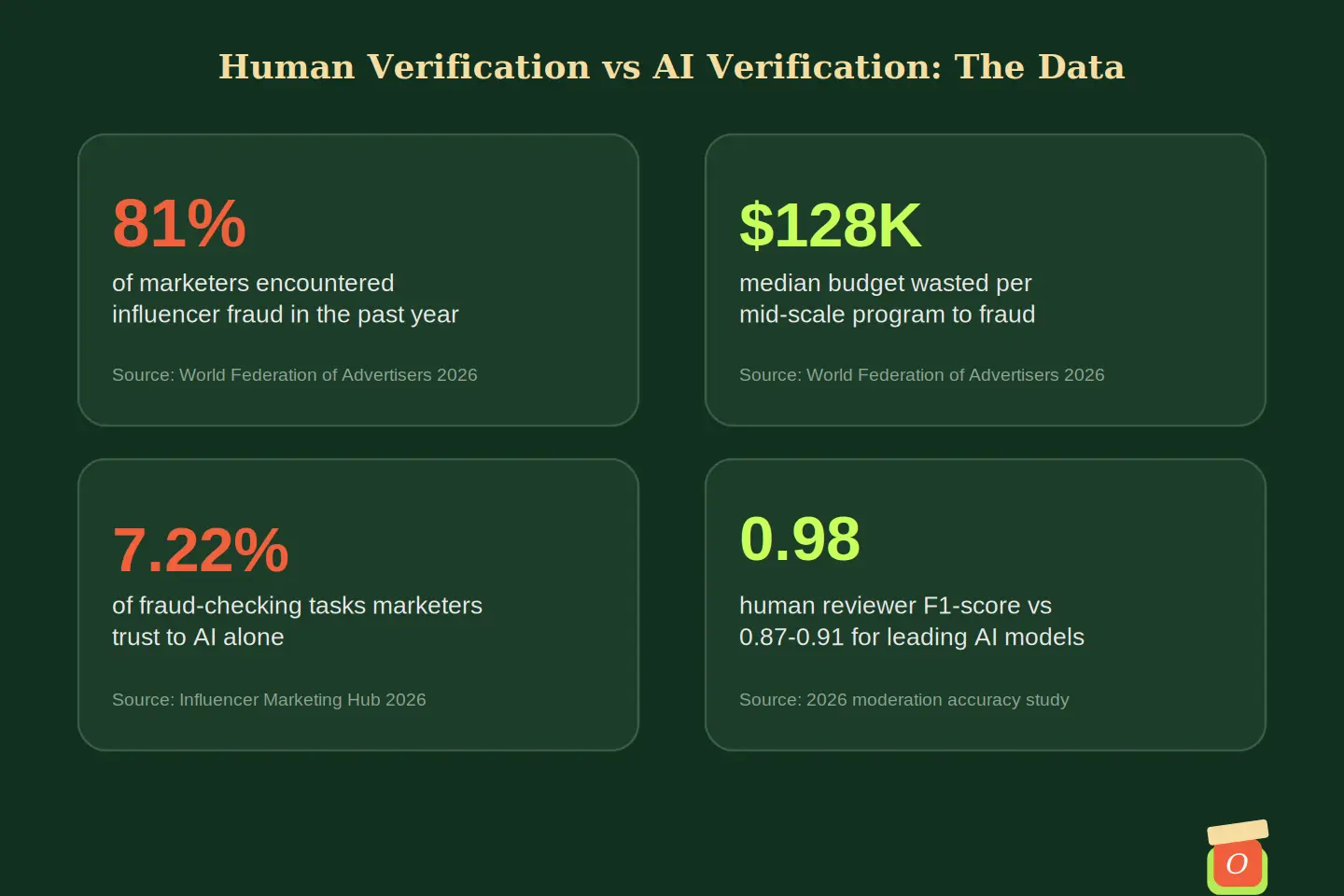
A cross-market study by the World Federation of Advertisers, spanning 1,400 senior marketers across 28 countries, found that 81 percent had encountered influencer fraud within the past year, with affected campaigns losing a median of $128,000 on a single mid-scale program. With numbers like that, it makes sense that brands want a fast, automated fix. Yet the same research shows marketers still trust AI with only about 7 percent of fraud-checking tasks, despite how much time manual review takes. That gap is the real story behind human verification vs AI verification, and it is not a story about picking a winner.
This guide breaks down exactly where AI verification excels, where it consistently falls short, what human reviewers catch that automated systems miss, and why the strongest platforms combine both rather than choosing sides. By the end, you should have a clear framework for deciding which parts of your own verification process genuinely need speed and which parts genuinely need judgment. It builds directly on our guide to why creator verification matters, going deeper into the specific methods behind that verification process.
Table of Contents
- Why Human Verification vs AI Verification Is the Wrong Question to Start With
- What AI Verification Does Well
- Where AI Verification Falls Short
- What Human Verification Does Well
- Where Human Verification Falls Short
- Why Combining Both Produces the Best Results
- Step-by-Step: How a Hybrid Verification Process Should Work
- Frequently Asked Questions About Human Verification vs AI Verification
Why Human Verification vs AI Verification Is the Wrong Question to Start With
Framing this as a competition assumes one approach should replace the other. In practice, the two solve different parts of the same problem, and treating them as rivals usually leads brands to under-invest in whichever one they picked as the loser, leaving a gap that fraud eventually finds.
The Real Question Is Where Each One Excels
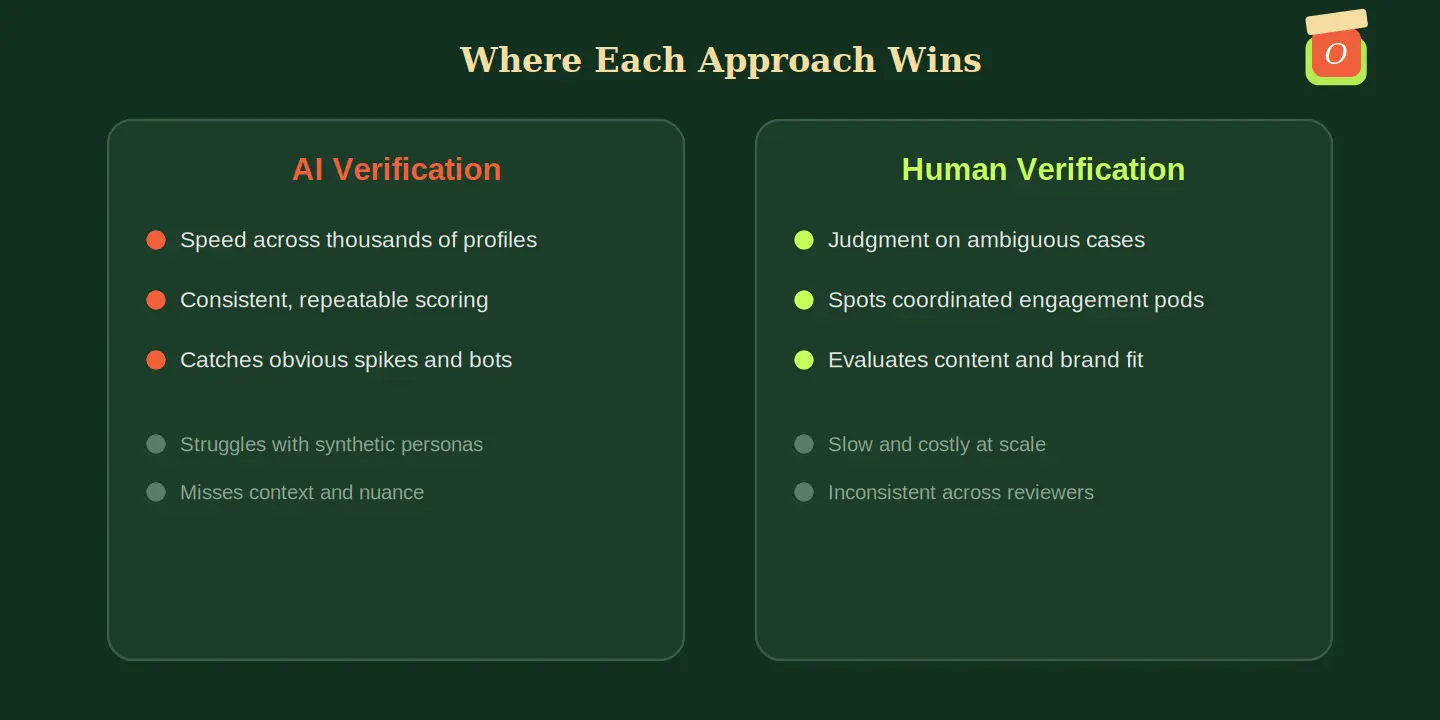
AI verification is built for scale and speed. Human verification is built for judgment and context. Asking which one is “better” skips the more useful question: which parts of the verification process actually need speed, and which parts actually need judgment, and how should a real system route each profile to the right kind of check.
81% of Marketers Have Already Been Burned
The scale of the fraud problem is exactly why this comparison matters right now. Influencer Marketing Hub’s 2026 benchmark data shows fake or bot followers account for 56.5 percent of reported fraud and quality issues, with inauthentic comments and manufactured engagement adding another 20.8 percent on top of that. Together, these two categories cover roughly 80 percent of the fraud problem brands face, and neither AI nor human review alone reliably catches all of it.
Why Neither Approach Works Fully Alone
Academic research on content moderation, a field that faces strikingly similar tradeoffs to influencer verification, consistently finds that hybrid systems combining automated screening with human oversight outperform either approach used in isolation. The same logic applies directly to creator verification, where automated tools and trained reviewers each cover gaps the other leaves open.
What AI Verification Does Well
Automated verification earns its place in the process for reasons that have nothing to do with replacing human judgment and everything to do with doing what humans simply cannot do at scale, particularly across a marketplace with tens of thousands of active creators.
Speed and Scale
AI systems can screen thousands of creator profiles in the time it would take a human reviewer to evaluate a handful. This speed is not a minor convenience. It is what makes verifying an entire marketplace of creators practically possible in the first place.
Catching Obvious Fraud Patterns
Sudden follower spikes, unusually high following-to-follower ratios, and engagement rates that fall wildly outside normal ranges are exactly the kind of pattern-based signals automated systems excel at flagging consistently and instantly. These patterns account for a meaningful share of total fraud, which is why automated screening alone still removes a lot of obvious risk before any human ever gets involved.
Consistency Across Every Check
An automated system applies the exact same criteria to every profile it reviews, without the fatigue, mood, or attention variance that affects even the most experienced human reviewer. This consistency matters most when a brand needs to compare hundreds of creators fairly against the same standard.
Where AI Verification Falls Short
The same speed that makes AI valuable also creates blind spots, particularly against fraud that is specifically designed to look normal to an automated system.
Synthetic Creators Built to Fool Detection
Fully AI-generated creator personas, described by industry researchers as the fastest-growing fraud category in 2026, are specifically built to avoid the pattern-based red flags automated tools look for. A synthetic account with a gradually built history and no obvious spike in growth can pass many automated checks that would catch a cruder, faster fraud attempt.
Context and Nuance
Automated systems struggle with situations that require understanding why something looks unusual rather than just detecting that it does. A legitimate viral moment can trigger the same growth-spike alert as a purchased follower batch, and only context distinguishes the two.
Why Marketers Still Hesitate to Trust It Alone
Marketers currently feel comfortable delegating only about 7.22 percent of fraud-checking tasks to AI on its own, according to Influencer Marketing Hub’s 2026 benchmark report, despite fraud detection being one of the highest-stakes parts of the vetting process. That hesitation reflects real, well-documented limitations rather than simple caution, since automated content detection tools across the wider industry still struggle to reliably catch sophisticated, deliberately disguised fraud. Even well-funded platforms with access to large volumes of training data have not closed this gap entirely, which is a strong signal that the limitation is structural rather than a matter of better engineering alone.
What Human Verification Does Well
Human reviewers bring exactly the kind of contextual judgment that automated pattern matching cannot replicate, particularly in the cases that matter most, where a wrong call means either missing real fraud or rejecting a genuinely strong creator.
Judgment on Ambiguous Cases
When a profile shows mixed signals, strong engagement but an unusual follower spike, or excellent content but a suspicious comment pattern, a trained human reviewer can weigh these factors together in a way that a scoring algorithm alone cannot. This judgment is exactly what separates a false alarm from a genuine problem.
Spotting Engagement Pods and Coordinated Behavior
Engagement pods, groups of real accounts that coordinate likes and comments across each other’s posts, are specifically difficult for automated systems to catch because every individual account involved is genuinely real and active. A human reviewer cross-referencing the same small cluster of accounts appearing across multiple unrelated creators’ posts can spot this coordination in a way pattern-based detection often misses entirely.
Evaluating Content Quality and Brand Fit
Beyond fraud detection, human reviewers can assess whether a creator’s tone, content style, and overall presentation genuinely fit a brand’s needs, a judgment call that goes well beyond authenticity scoring. This qualitative layer is part of what separates a technically legitimate creator from one who will actually deliver a strong campaign.
Where Human Verification Falls Short
Human review is not a flawless substitute for automation. Its limitations are simply different from AI’s, centered on scale and consistency rather than context.
Speed and Scale Limits
No reasonably sized human team can manually review every creator profile across a marketplace with tens of thousands of active accounts. Relying on human review alone forces brands to either drastically limit their creator search or accept much slower turnaround times.
Reviewer Inconsistency
Different human reviewers can reach different conclusions about the same borderline profile, depending on experience, attention, and even how many profiles they have already reviewed that day. This inconsistency makes human-only verification harder to standardize across a large team than an automated scoring system.
Cost at Volume
Paying trained reviewers to manually check every single profile becomes expensive quickly, especially for platforms or brands operating at meaningful scale. This cost pressure is exactly why relying on human review alone is rarely sustainable beyond a small, curated list of creators, and why most teams eventually look for a way to reduce the volume of profiles that require full manual attention.
Why Combining Both Produces the Best Results
The strongest verification systems do not treat this as an either-or decision. They assign each method to the part of the process it handles best, building a workflow where automation and human judgment reinforce rather than compete with each other.
AI as the First Filter
Automated screening handles the initial pass across every profile, flagging obvious red flags like follower spikes, bot-like accounts, and engagement rates far outside normal ranges. This filters out a meaningful share of low-quality or fraudulent profiles before any human time gets spent on them.
Humans as the Final Check
Profiles that pass initial automated screening, along with any that get flagged as ambiguous, go to human reviewers who can apply the contextual judgment automated systems lack. This two-stage approach mirrors the same conclusion reached in broader content moderation research: combining automated and human review consistently outperforms either one alone, across nearly every comparable use case studied so far.
How Brand-O-fluence Combines Both
Every creator on Brand-O-fluence goes through automated pattern detection first, followed by manual human review before the profile becomes searchable. This matches the layered approach covered in our guide on how brands can avoid fake influencers, where combining automated and manual review is one of the core pillars of genuine fraud prevention, not just a nice-to-have feature.
Consider a Bengaluru-based skincare brand evaluating a mid-tier creator whose profile triggered an automated growth-spike alert during initial screening, the kind of signal that typically points to a purchased follower batch. A purely automated system would have rejected the profile outright based on that single signal, closing the door on the partnership before anyone looked deeper. Human review found the spike coincided with a creator’s appearance on a popular regional podcast, a legitimate, verifiable event that explained the sudden follower growth without any sign of purchased engagement. The brand moved forward with the partnership, which went on to outperform two other creators in the same campaign who had passed automated screening without triggering any review at all.
Step-by-Step: How a Hybrid Verification Process Should Work
Use this sequence as a model for how automated and human review should divide the work in any verification system.
- Run automated screening first: Score every profile for follower authenticity, engagement rate, and growth pattern anomalies.
- Auto-approve clear passes: Let profiles with no red flags and strong metrics move forward without unnecessary manual delay.
- Flag ambiguous or borderline cases: Route profiles with mixed signals to human reviewers rather than auto-rejecting them.
- Apply human judgment to flagged profiles: Have trained reviewers investigate context behind any flagged anomaly before a final decision.
- Check for coordinated engagement patterns: Use human cross-referencing to catch engagement pod behavior automated tools may miss.
- Re-run automated checks periodically: Keep verification current with recurring automated screening rather than a single one-time pass.
- Feed outcomes back into the system: Use confirmed human findings to continuously improve what the automated layer flags going forward.
AI-Only vs Human-Only vs Hybrid Verification
The table below compares all three approaches across the factors that matter most to brands.
| Factor | AI-Only | Human-Only | Hybrid |
|---|---|---|---|
| Speed at Scale | Very fast | Slow beyond small volumes | Fast, with targeted review |
| Catches Obvious Fraud | Strong | Strong, but slower | Strong and fast |
| Catches Subtle or Coordinated Fraud | Weak | Strong | Strong |
| Consistency | Very high | Variable by reviewer | High, with human oversight |
| Cost at Volume | Low | High | Moderate, focused where needed |
Frequently Asked Questions About Human Verification vs AI Verification
Is AI verification alone enough to trust a creator?
No, AI verification catches many obvious fraud patterns but struggles with sophisticated fraud specifically designed to avoid automated detection, including synthetic personas and coordinated engagement pods. Marketers currently trust AI with only about 7 percent of fraud-checking tasks on its own, reflecting these well-documented limitations. Combining automated screening with human review closes most of this gap.
Why not just use human reviewers for everything?
Human review does not scale efficiently across a large marketplace of creators, and manually checking every profile becomes slow and expensive quickly. Reviewer inconsistency is also a real concern, since different people can reach different conclusions about the same borderline case. Automated screening handles the volume so human attention can focus on the cases that genuinely need judgment.
How much does hybrid verification actually improve accuracy?
Research on comparable content moderation systems consistently shows that combining automated screening with human oversight outperforms either approach alone, since each method covers the other’s specific weaknesses. Automated tools catch obvious, scalable patterns instantly, while human reviewers catch the context-dependent cases automation misses. The exact improvement varies by platform, but the general conclusion holds across the research.
Can AI verification eventually replace human review entirely?
Unlikely in the near term, since fraud tactics continue evolving specifically to avoid automated detection, and new categories like fully synthetic creator personas require the kind of contextual judgment automation still struggles with. As automated tools improve, the balance may shift toward AI handling a larger share of routine cases, but human oversight remains valuable for ambiguous and high-stakes decisions. The trend in comparable fields points toward better collaboration between the two rather than full replacement.
How does Brand-O-fluence balance AI and human verification?
Every creator profile goes through automated screening first, which flags obvious red flags and clears profiles that show no signs of risk. Flagged or ambiguous profiles then go to human reviewers who apply the contextual judgment automated systems cannot replicate. This two-stage approach keeps verification fast enough to scale across a large marketplace while still catching the subtler fraud that automation alone would miss.
Human verification vs AI verification is not a contest with a single winner, and treating it that way leaves real gaps in any brand’s protection. AI verification brings speed and consistency at a scale no human team could match, while human verification brings judgment and context that automated systems still cannot fully replicate. The brands and platforms getting this right are the ones combining both, using automation to filter at scale and human review to catch what automation misses, rather than betting everything on a single method.
If you want verification that actually combines both strengths, explore Brand-O-fluence today. Every creator profile passes through automated screening and manual human review before it ever appears in search results, giving you the speed of AI and the judgment of trained reviewers in a single system. Whether you are vetting one creator or building a shortlist of dozens, the same combined process applies consistently every time. Start working with creators verified by both approaches on Brand-O-fluence instead of trusting either one alone.
Leave a Reply