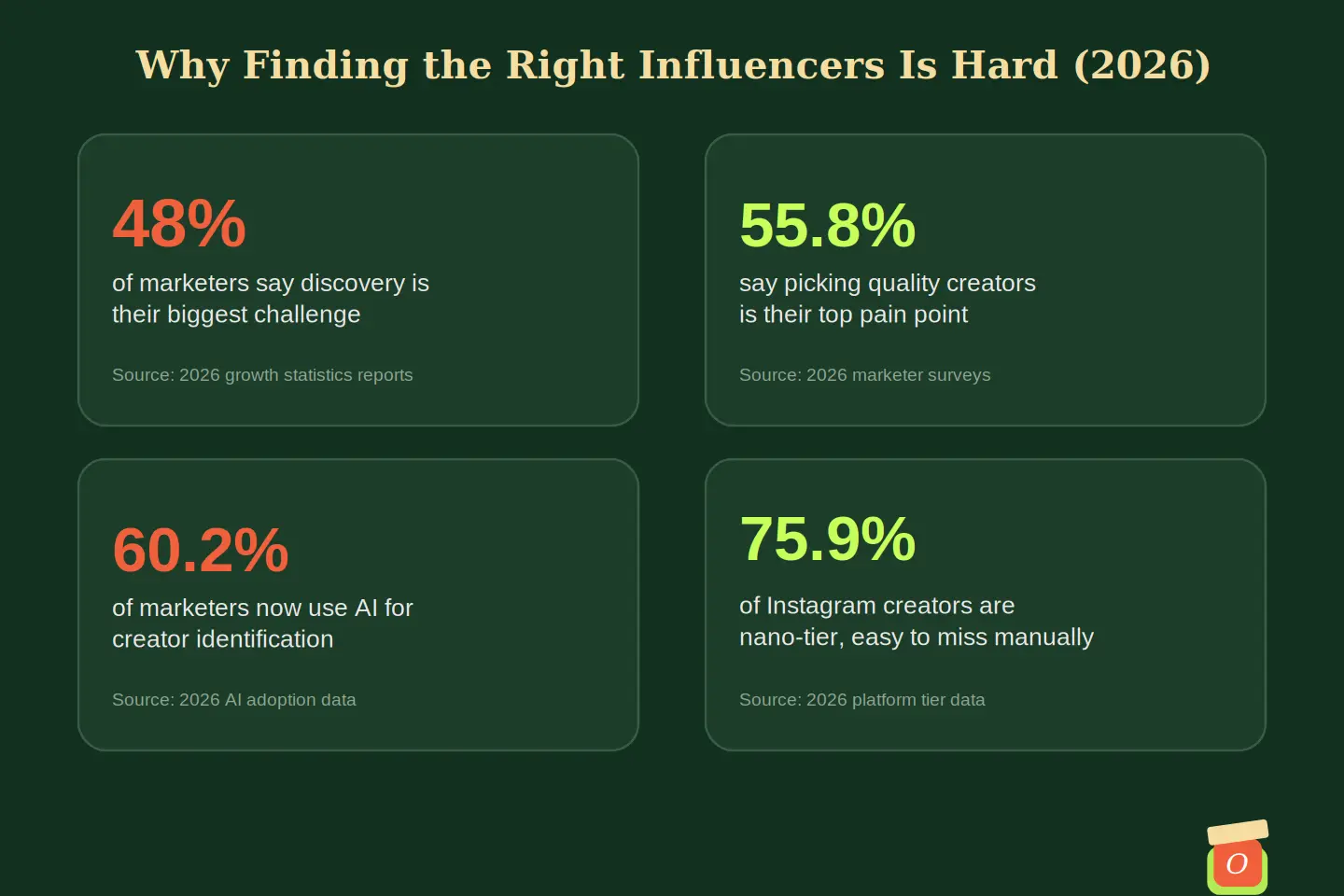
Nearly half of all marketers, close to 48 percent, say discovery is the single hardest part of running an influencer campaign. Not budget. Not content approval. Just finding the right person to work with in the first place. If you have ever spent an entire afternoon scrolling hashtags and still ended up with a shortlist you were not confident in, you already know why this statistic is so high.
Learning how to find the right influencers for your brand is less about luck and more about using the right filters, checking the right data, and skipping the guesswork that manual search forces on you. This guide covers what actually matters when you search for creators, where most brands go wrong, and how a verified platform like Brand-O-fluence turns a multi-week search into a same-day shortlist. By the end, you should have a clear, repeatable process you can use for every campaign instead of starting from scratch each time.
Table of Contents
- Why Finding the Right Influencers for Your Brand Is Harder Than It Looks
- Key Criteria to Find the Right Influencers for Your Brand
- Where Brands Search for Influencers Today
- How to Find the Right Influencers for Your Brand Using Filters
- How to Verify an Influencer Before You Reach Out
- How Brand-O-fluence Helps You Find the Right Influencers for Your Brand
- Step-by-Step: Finding and Shortlisting Influencers
- Frequently Asked Questions About Finding the Right Influencers
Why Finding the Right Influencers for Your Brand Is Harder Than It Looks
Search a niche hashtag on Instagram and you will get thousands of results with no way to sort by what actually matters. Instagram’s own discovery tools were designed to help users find content to enjoy, not to help brands evaluate creators for a paid partnership. This mismatch is exactly why so many brands still describe creator discovery as their number one pain point, even ahead of budget and content approval.
The Follower Count Trap
Follower count is the easiest number to see and the least reliable one to trust. A profile with 200,000 followers can perform worse than one with 20,000 if the larger account is full of inactive or purchased followers. Brands that sort creators by follower count alone are optimizing for the wrong metric from the very first step.
Time Lost to Manual Instagram Search
Scrolling hashtags, checking bios, and messaging creators one by one can eat up days or weeks before a single deal is even discussed. Most in-house marketing teams do not have that kind of spare bandwidth every time they want to run a campaign. This is one of the clearest reasons brands eventually move to a dedicated discovery platform instead of repeating the manual process every quarter.
Why Fit Matters More Than Fame
A mid-size creator whose audience already cares about your product category will usually outperform a bigger name with a mismatched audience. Fit means the creator’s content style, tone, and existing followers naturally overlap with your target customer. Chasing fame instead of fit is one of the most common reasons influencer campaigns underperform, even with a healthy budget.
Key Criteria to Find the Right Influencers for Your Brand
Before you open Instagram or any discovery tool, it helps to know exactly what you are filtering for. These three criteria matter far more than follower count on its own.
Niche and Content Style
A skincare brand needs a creator who already talks about skincare, not a general lifestyle account that occasionally posts about beauty. Content style matters too. A creator who films fast, punchy Reels is a poor fit for a brand that needs longer, detailed tutorial-style content.
Audience Demographics and Location
Age, gender split, and city-level data tell you whether a creator’s followers actually look like your target customer. A fitness brand targeting Tier 2 cities gains little from a Mumbai-based creator whose audience is concentrated in South Delhi. Checking this data before outreach saves you from campaigns that reach the wrong people entirely.
Engagement Rate Over Follower Count
Engagement rate tells you how many people actually interact with a creator’s content, which is a far better predictor of campaign performance than raw follower count. Nano and micro creators consistently post stronger engagement rates than larger accounts, which is part of why they now make up the vast majority of Instagram’s creator base. A high follower count with a low engagement rate is often a warning sign, not a selling point. For example, a beauty brand comparing two creators, one with 150,000 followers and 0.8 percent engagement, another with 22,000 followers and 6.5 percent engagement, will almost always see stronger comment activity, saves, and click-throughs from the smaller account despite the huge gap in reach.
Where Brands Search for Influencers Today
Most brands fall into one of three approaches when they start looking for creators, and each comes with its own trade-offs in cost, speed, and reliability. Knowing the strengths and limits of each option upfront helps you pick the right one for your budget and timeline instead of defaulting to whatever method you used last time.
- Manual hashtag and Instagram search: Free but extremely slow, with no reliable way to verify engagement or audience quality.
- Influencer marketing agencies: Faster than manual search, but often expensive and slower to react to last-minute campaign changes.
- Verified discovery platforms: Combine speed, filters, and verification in one place, letting brands run the search themselves without giving up data quality.
Manual Hashtag and Instagram Search
This is where most brands start, and it is also where most of the wasted time happens. Instagram’s own search tools were built for browsing content, not for filtering creators by engagement rate or audience city. It works for small, one-off campaigns, but it does not scale.
Influencer Marketing Agencies
Agencies bring relationships and experience, which can be valuable for large, complex campaigns. The trade-off is usually cost and speed, since agency-managed campaigns often take longer to launch and carry higher fees than a self-serve platform. For brands running frequent, smaller campaigns, this overhead adds up quickly.
Verified Discovery Platforms
A dedicated platform lets a brand’s own marketing team search, filter, and shortlist creators directly, with verification handled in the background. This approach keeps the speed and control of manual search while removing the guesswork around fake followers and inflated metrics. It is quickly becoming the default choice for brands that want to scale beyond one or two campaigns a year.
How to Find the Right Influencers for Your Brand Using Filters
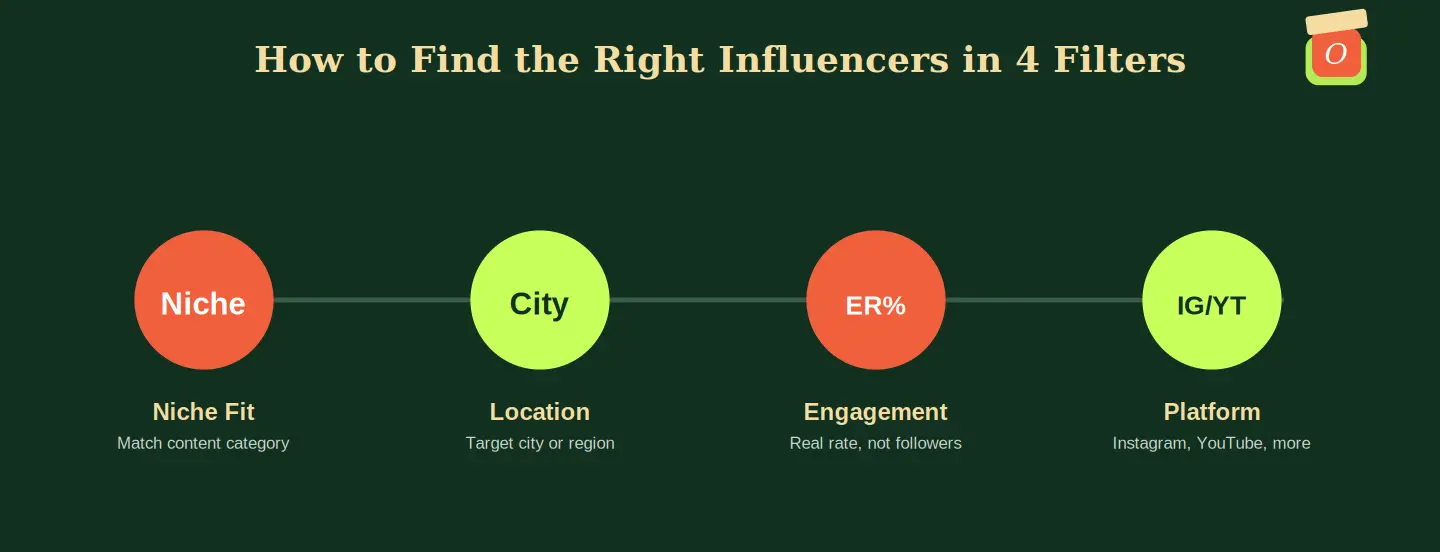
The fastest way to find the right influencers for your brand is to filter for the criteria that matter before you ever look at a single profile. Think of it the same way you would filter a product search on an e-commerce site: you set your constraints first, then browse only the results that already fit, instead of scrolling through everything and hoping something useful shows up.
Filter by Niche
Start by narrowing your search to a specific content category, such as skincare, fitness, personal finance, or home decor. This single filter alone removes the vast majority of irrelevant profiles from your search before you spend any time reviewing them.
Filter by City and Language
If your product sells better in certain regions, filter directly by city or by the language a creator posts in. This is especially useful for D2C brands targeting specific metro areas or brands expanding into Tier 2 and Tier 3 cities with vernacular content needs.
Filter by Platform and Follower Range
Instagram, YouTube, and other platforms attract different content styles and audience behavior, so filtering by platform keeps your search aligned with where your campaign will actually run. Pairing that with a follower range, such as nano, micro, or mid-tier, keeps your shortlist within budget from the very first search.
How to Verify an Influencer Before You Reach Out
Filtering narrows your list. Verification protects your budget once you have a shortlist worth pursuing.
Check Engagement Rate Against Followers
Compare a creator’s average likes and comments to their follower count. A healthy engagement rate for a nano or micro creator in India typically falls between 3 and 10 percent, depending on tier, while anything far below that range on a large account deserves a closer look.
Review Audience Insights, Not Screenshots
Screenshots can be edited, cropped, or simply outdated by the time you see them. Genuine audience insights pulled directly from platform data show real follower age, gender split, and location, which is a much harder thing to fake convincingly.
Look at Past Brand Collaborations
A creator’s history with other brands tells you how professional and reliable they are likely to be. Look for consistent posting schedules, clear disclosure of sponsored content, and comments that suggest genuine audience reactions rather than bot-like activity.
How Brand-O-fluence Helps You Find the Right Influencers for Your Brand
Brand-O-fluence was built to replace the slow, manual side of creator discovery with a search experience closer to filtering products on an e-commerce site. If you want the full picture of why this approach pays off, our guide on the benefits of influencer marketing for brands breaks down the ROI side in more depth.
Search by Niche, City, and Follower Count
Instead of scrolling hashtags, brands set their filters once and get a ranked list of creators that already match their niche, target city, and preferred follower range. This turns a search that used to take days into one that takes minutes.
Search by Platform and Engagement
Brands can narrow results further by platform and by real engagement rate, not just follower count. This keeps the shortlist focused on creators who are actually likely to perform well for the specific campaign goal, whether that is awareness, engagement, or direct sales.
Verified Audience Insights Built In
Every profile on Brand-O-fluence includes audience insights and engagement data verified against platform APIs and reviewed by a human team, not a screenshot the creator chose to share. This is part of the same verification approach covered in our deeper look at where influencer marketing in India is heading in 2026, including the compliance and trust pressures pushing every serious platform toward stronger verification.
Consider a Pune-based fashion label preparing a festive season launch. Its team had previously spent close to two weeks manually shortlisting creators for a similar campaign, only to discover after payment that two of the four influencers had heavily inflated follower counts. On Brand-O-fluence, the same team filtered by niche, city, and minimum engagement rate, reviewed verified audience insights for the top matches, and finalized a shortlist of six creators in under a day. The difference was not luck. It was simply searching with the right filters and checking real data before committing budget.
Step-by-Step: Finding and Shortlisting Influencers
Use this sequence the next time you need to build a creator shortlist from scratch.
- Define your campaign goal: Decide if you are optimizing for awareness, engagement, or direct conversions before you search.
- Set your niche and city filters: Narrow the pool to creators whose content and location already match your target customer.
- Set a follower and platform range: Choose nano, micro, or mid-tier creators on the platform where your audience spends the most time.
- Sort by engagement rate: Rank your filtered results by real engagement rate instead of follower count alone.
- Review verified audience insights: Check age, gender, and location data for your top candidates before reaching out.
- Shortlist 8 to 12 creators: Keep your outreach list focused rather than messaging dozens of profiles at once.
- Send a clear, specific brief: Share your goals, deliverables, and budget upfront to avoid slow back-and-forth negotiation.
Manual Search vs Agencies vs Brand-O-fluence
The table below compares the three most common ways brands find influencers today.
| Factor | Manual Search | Agency | Brand-O-fluence |
|---|---|---|---|
| Cost | Low, but time-heavy | High, retainer or commission | Transparent, campaign-based |
| Search Speed | Days to weeks | Several days | Minutes to hours |
| Filter Options | Hashtags only | Depends on agency roster | Niche, city, platform, engagement |
| Verification | None | Varies by agency | Human and API verified |
| Scalability | Poor beyond one campaign | Good, but costly at scale | Built for repeat campaigns |
Frequently Asked Questions About Finding the Right Influencers
How do I find the right influencers for my brand on a small budget?
Start with nano and micro creators, since they typically charge less than larger accounts while delivering stronger engagement rates. Filter by niche and city first to avoid wasting outreach on creators outside your target audience. A verified discovery platform can also help you compare options quickly without paying agency fees.
What is a good engagement rate to look for?
In India, nano creators often average 5 to 10 percent engagement, micro creators average 3 to 6 percent, and accounts above 100,000 followers typically fall to 1 to 3 percent. Anything far below these ranges for a given tier is worth investigating before you commit budget. Engagement rate is a stronger performance signal than follower count alone.
How many influencers should I shortlist before reaching out?
A shortlist of 8 to 12 creators is usually enough to find 3 to 5 strong matches after initial conversations and rate negotiations. Going much smaller risks having no backup if a creator declines or is unavailable. Going much larger often wastes time on outreach you will not follow through on.
Should I prioritize follower count or audience fit?
Audience fit should almost always come first, since a smaller but highly relevant audience converts better than a large but mismatched one. Follower count only matters once you have already confirmed the creator’s niche, location, and engagement rate align with your campaign goal. Chasing follower count alone is one of the most common mistakes brands make.
Can I find influencers without using an agency or platform?
Yes, it is possible through manual search, but it takes significantly more time and offers no built-in way to verify engagement or audience data. This approach works for very small, occasional campaigns but becomes difficult to sustain once you want to run multiple campaigns a year. Most growing brands eventually move to a discovery platform to save time and reduce risk.
Knowing how to find the right influencers for your brand comes down to filtering for fit before fame, checking real engagement instead of follower count, and verifying audience data before you ever send a message. Manual search can work for a single small campaign, but it does not scale, and agencies solve speed at the cost of budget flexibility. A verified discovery platform gives you the control of manual search with the speed and trust of a professional process.
If you are ready to stop guessing and start finding creators who actually fit your brand, explore Brand-O-fluence today. Filter by niche, city, platform, and engagement rate in minutes, review verified audience insights before you reach out, and move straight into a campaign once you find the right match. Start your search on Brand-O-fluence and see how fast the right influencer shortlist can come together.
Leave a Reply