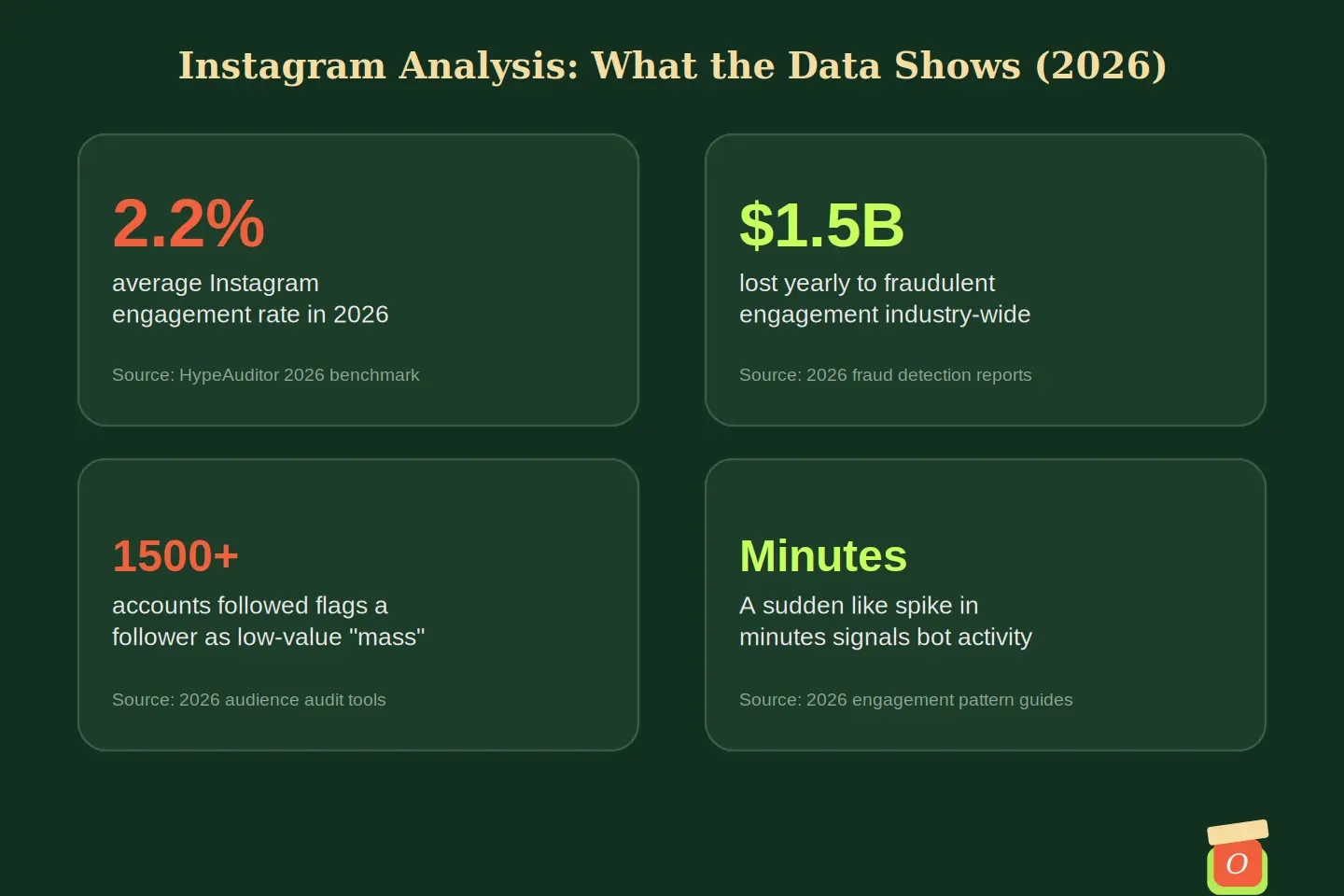
The influencer marketing industry loses an estimated $1.5 billion every year to fraudulent engagement, money spent on reach that never existed and audiences that were never real. At the same time, the average Instagram engagement rate has dropped to just 2.2 percent in 2026, making it harder than ever to tell a genuinely strong profile from an average one at a glance. If you are still judging creators by their follower count and a quick scroll through their grid, you are almost certainly leaving money on the table.
Learning how to analyze Instagram influencers properly means going past the profile photo and bio, checking real engagement patterns, and verifying audience data before you ever discuss a rate. This guide walks through exactly how to do that, step by step, along with the red flags that separate genuine creators from inflated ones, and how a verified platform like Brand-O-fluence handles this analysis automatically. By the end, you will have a repeatable checklist you can run through in minutes for every creator you consider, rather than relying on a quick scroll and a gut feeling. If you have not yet worked through the broader evaluation process, our guide on how to choose the perfect influencer for your brand covers the full decision framework this analysis feeds into.
Table of Contents
- Why You Need to Analyze Instagram Influencers Before Any Deal
- Step-by-Step: How to Analyze Instagram Influencers Manually
- How to Spot Fake Followers and Bot Engagement
- Reading Audience Demographics the Right Way
- Tools vs Manual Analysis: What Actually Works
- How Brand-O-fluence Simplifies Instagram Influencer Analysis
- Step-by-Step Checklist: Analyzing an Instagram Influencer in 10 Minutes
- Frequently Asked Questions About How to Analyze Instagram Influencers
Why You Need to Analyze Instagram Influencers Before Any Deal
Skipping analysis feels faster in the moment, but it usually costs far more later, either through wasted budget or a campaign that never had a real chance of reaching the right audience. A few minutes of checking upfront routinely saves brands from mistakes that only become obvious once a campaign has already gone live.
The $1.5 Billion Fraud Problem
Purchased followers, bought likes, and comment pod manipulation are common enough across the industry that any brand skipping fraud checks is statistically likely to be paying for at least some hollow numbers. This is not a niche problem limited to small creators either, since even accounts with large followings can carry a meaningful percentage of inactive or fake accounts.
Instagram’s Engagement Rates Are Falling
The overall average engagement rate on Instagram has dropped to 2.2 percent in 2026, partly because attention has shifted toward Reels and Stories rather than static feed posts. This makes it more important than ever to compare a creator against a relevant benchmark for their specific tier and content format, rather than judging every profile against an outdated average.
What Analysis Actually Prevents
Proper analysis prevents three costly outcomes: paying inflated rates based on fake followers, discovering after the fact that a creator’s audience does not match your target customer, and launching a campaign with a creator whose engagement was never as strong as it appeared. Each of these is preventable with a relatively small amount of checking before you ever sign a contract.
Step-by-Step: How to Analyze Instagram Influencers Manually
Even without a paid tool, a structured manual process catches most of the obvious problems before you commit any budget. Working through these steps in order, rather than jumping straight to engagement rate, helps you build a fuller picture of each creator before you decide whether they are worth pursuing.
Check the Profile Basics
Start with the fundamentals: how long has the account existed, how consistently do they post, and does their bio and content match the niche you are hiring for. A creator who suddenly pivoted from an unrelated niche a few months ago is worth a closer look before you move forward.
Calculate Engagement Rate
Add together the likes and comments on a recent post, divide by the follower count, and multiply by 100 to get a percentage. Repeat this across five to ten recent posts rather than just one, since a single viral post can make engagement look far stronger than it typically is.
Review Recent Content Quality
Look at how a creator frames products in past sponsored posts, whether they disclose partnerships clearly, and how their audience responds in the comments. Content that reads as genuinely useful or entertaining, rather than purely promotional, tends to perform better for the brands that sponsor it.
How to Spot Fake Followers and Bot Engagement
Fake followers and bot engagement leave patterns that are detectable once you know what to look for, even without specialized software. None of these checks require advanced technical skill, just a willingness to look slightly closer than a quick glance at the follower count.
Engagement Pods and Timing Patterns
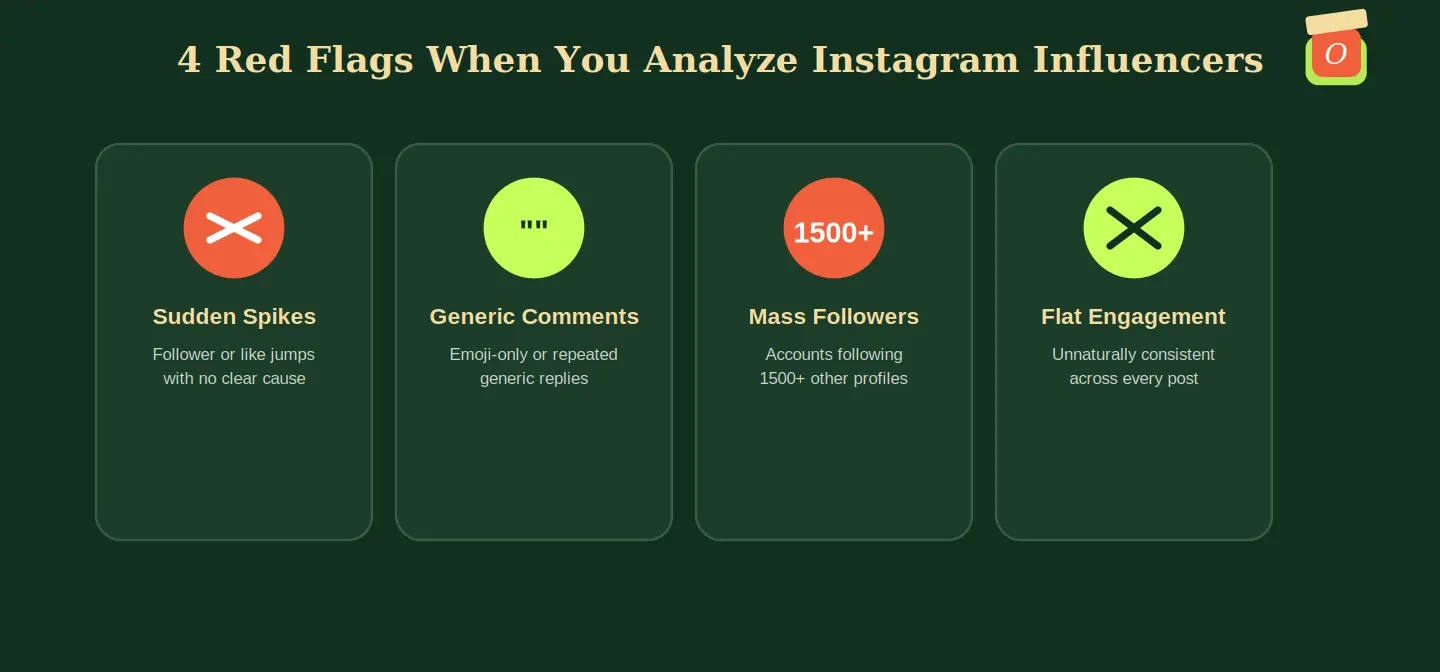
Engagement pods are groups of accounts that agree to like and comment on each other’s posts, and they are harder to spot than simple bots but still leave clues. Watch for identical comment timing, the same small group of accounts appearing on every post, and comments that arrive in a tight cluster immediately after publishing.
Generic Comments and Mass Followers
Comments that only say things like “great post” or consist entirely of emoji, especially from accounts with little or no other activity, are a common sign of bots or purchased engagement. Mass followers, meaning accounts that follow more than 1,500 other profiles, are another red flag, since these accounts are unlikely to see or genuinely engage with any single creator’s content.
Sudden Follower or Like Spikes
A jump from 90 likes to 2,000 likes within a few minutes of posting is a strong indicator of purchased engagement, since organic likes accumulate gradually rather than arriving all at once. The same logic applies to follower growth. A sudden spike with no corresponding viral moment, press mention, or collaboration is worth investigating before you trust the number.
Reading Audience Demographics the Right Way
Engagement quality tells you whether an audience is real. Demographic data tells you whether that audience is actually relevant to your brand.
Age, Gender, and Location Data
Age and gender breakdowns confirm whether a creator’s audience matches your target buyer, while location data shows where that audience is concentrated. A creator can have an authentic, highly engaged audience that still does not overlap with the customer you are trying to reach, which is why this check matters just as much as fraud detection.
Real People vs Mass Followers vs Influencers
A thorough audience breakdown typically separates followers into categories such as real people, mass followers, and other influencers, since each behaves differently in terms of engagement and reach. A high percentage of real, active people in a creator’s follower base is a much stronger signal than raw follower count alone.
Matching Audience to Your Buyer Persona
Once you have demographic data in hand, compare it directly against your actual customer profile rather than a general assumption about who might be interested in your product. A close match between audience data and buyer persona is one of the clearest predictors of whether a campaign will convert.
Tools vs Manual Analysis: What Actually Works
Manual checking catches a lot, but it has real limits, especially once you are evaluating more than a handful of creators at once.
Limits of Manual Checking
Manually reviewing comment timing, follower ratios, and content history across dozens of profiles is slow and easy to apply inconsistently from one creator to the next. It also cannot access certain data, such as verified audience demographics, that platforms only expose through official API access. This gap becomes especially noticeable once a brand tries to scale from one or two campaigns a year to running several at once.
What Paid Audit Tools Offer
Dedicated audit tools automate fake follower detection, engagement rate calculation, and audience demographic breakdowns, often for a monthly fee. These tools are genuinely useful, but they add another subscription and another login to an already crowded marketing stack, and results still need to be interpreted correctly.
Why Built-In Platform Verification Wins
The most efficient approach combines this kind of verification directly into the same platform where you discover and manage creators, so you are not exporting data between three or four separate tools. This keeps analysis consistent across every profile you review and removes the friction that causes many brands to skip proper vetting altogether.
How Brand-O-fluence Simplifies Instagram Influencer Analysis
Brand-O-fluence was built to remove the manual grind from Instagram influencer analysis without sacrificing the depth of a dedicated audit tool.
Verified Data Straight From the Graph API
Engagement rate, reach, and story performance are pulled directly from the Instagram Graph API rather than self-reported screenshots, which removes most of the guesswork covered in our detailed breakdown of why influencer analytics matter for campaign performance. This keeps every profile on the platform measured against the same consistent, verifiable standard.
Historical Performance on Every Profile
Instead of only seeing a creator’s current snapshot, brands can review engagement trends and prior campaign signals over time, making it easier to catch a recent, unexplained spike or a gradual decline in genuine audience interest. This historical view is often what separates a confident decision from a risky guess.
No Manual Spreadsheets Required
All of this analysis lives inside the same platform used for discovery, briefing, and payment, so brands are not exporting data into spreadsheets or juggling multiple logins just to compare a handful of creators. This is the same efficiency gain covered in our guide on how to find the right influencers for your brand, where filtering and verification work together in a single search.
Consider a Chennai-based apparel brand comparing two creators before committing to a large bulk order of sponsored content. Manual review of both profiles looked similar at first glance, with comparable follower counts and posting frequency, and either creator would likely have passed a quick, surface-level check. Verified analytics on Brand-O-fluence revealed that one creator’s audience was concentrated in cities outside the brand’s delivery zones, while the other had a genuine 4.9 percent engagement rate with an audience closely matched to the brand’s actual customer base. The brand redirected its full budget to the second creator, avoiding a partnership that manual review alone would likely have approved.
Step-by-Step Checklist: Analyzing an Instagram Influencer in 10 Minutes
Use this quick sequence whenever you need to vet a creator without a lengthy manual audit.
- Check account age and consistency: Confirm the profile has an established, steady posting history in your niche.
- Calculate engagement rate across multiple posts: Average results from five to ten recent posts, not just one.
- Scan comments for authenticity: Look for genuine, specific comments rather than generic or emoji-only replies.
- Check for mass followers: Spot-check a sample of followers for accounts following an unusually high number of profiles.
- Review audience demographics: Confirm age, gender, and location data align with your target customer.
- Look for unexplained spikes: Check follower growth history for sudden jumps with no clear cause.
- Compare against tier benchmarks: Judge engagement against the expected range for that creator’s specific follower tier, not a flat industry average.
Instagram Engagement Benchmarks by Creator Tier
Use the table below as a rough guide when judging whether a creator’s engagement rate is genuinely strong for their size.
| Creator Tier | Follower Range | Typical Engagement Rate | What to Watch For |
|---|---|---|---|
| Nano | 1K to 10K | 5% to 10%+ | Very low rates despite small size |
| Micro | 10K to 100K | 3% to 6% | Flat rates across every post |
| Mid-tier | 100K to 500K | 2% to 4% | Sudden recent follower growth |
| Macro and Above | 500K and up | 1% to 3% | High mass follower percentage |
Frequently Asked Questions About How to Analyze Instagram Influencers
What is a good engagement rate on Instagram in 2026?
The overall Instagram average sits at around 2.2 percent, but a genuinely good rate depends heavily on the creator’s follower tier, since nano and micro creators typically post much higher rates than large accounts. Anything meaningfully above the benchmark for a specific tier is considered strong. Anything far below it deserves a closer look before committing budget.
How can I tell if an Instagram influencer has fake followers?
Check for generic, repetitive comments, unusually high numbers of accounts following more than 1,500 profiles, and sudden follower or like spikes with no clear explanation. Reviewing engagement across multiple posts rather than just one also helps reveal whether a strong number is consistent or a one-time anomaly. Verified audit tools can automate most of this checking at scale.
How long does it take to properly analyze an Instagram influencer?
A focused manual check using the steps in this guide typically takes about 10 to 15 minutes per creator, though reviewing a larger shortlist naturally takes longer. Verified platforms that surface this data automatically can cut that time down significantly, since much of the calculation and pattern detection happens instantly. Speed matters more once you are comparing several creators for the same campaign.
Are paid Instagram audit tools worth the cost?
Paid audit tools can be worthwhile for brands running frequent campaigns, since they automate fake follower detection and demographic breakdowns that would otherwise take significant manual effort. For occasional campaigns, a manual check combined with a verified discovery platform often covers the same ground without an extra subscription. The right choice depends on how often you are vetting new creators and how much of that process you want built into your existing campaign workflow rather than handled through a separate tool.
Does a high engagement rate always mean a creator is trustworthy?
Not necessarily, since engagement pods and coordinated bot activity can produce engagement rates that look strong on the surface while being largely inauthentic. Checking comment quality, timing patterns, and audience demographics alongside the raw engagement percentage gives a much more reliable picture. A single strong-looking metric should never be the only factor in a final decision.
Knowing how to analyze Instagram influencers properly protects your budget from the two biggest risks in creator marketing: fake engagement and audience mismatch. A quick manual check across engagement rate, comment quality, and follower patterns catches many of the obvious problems, while verified audience data confirms whether a genuinely real audience actually matches your target customer. The brands that build this analysis into every campaign consistently make better decisions than those relying on follower count and a quick scroll through the grid, and over time this habit compounds into a much stronger track record across every creator partnership they run.
If you want this analysis handled for you automatically, explore Brand-O-fluence today. Every creator profile includes verified engagement data, audience demographics, and historical performance pulled directly from the platform, so you can skip the manual audit entirely. Whether you are vetting one creator or comparing twenty for the same campaign, the process stays just as fast and just as reliable. Start analyzing Instagram influencers with real data on Brand-O-fluence instead of guessing from a follower count and a few scrolls through their feed.
Leave a Reply