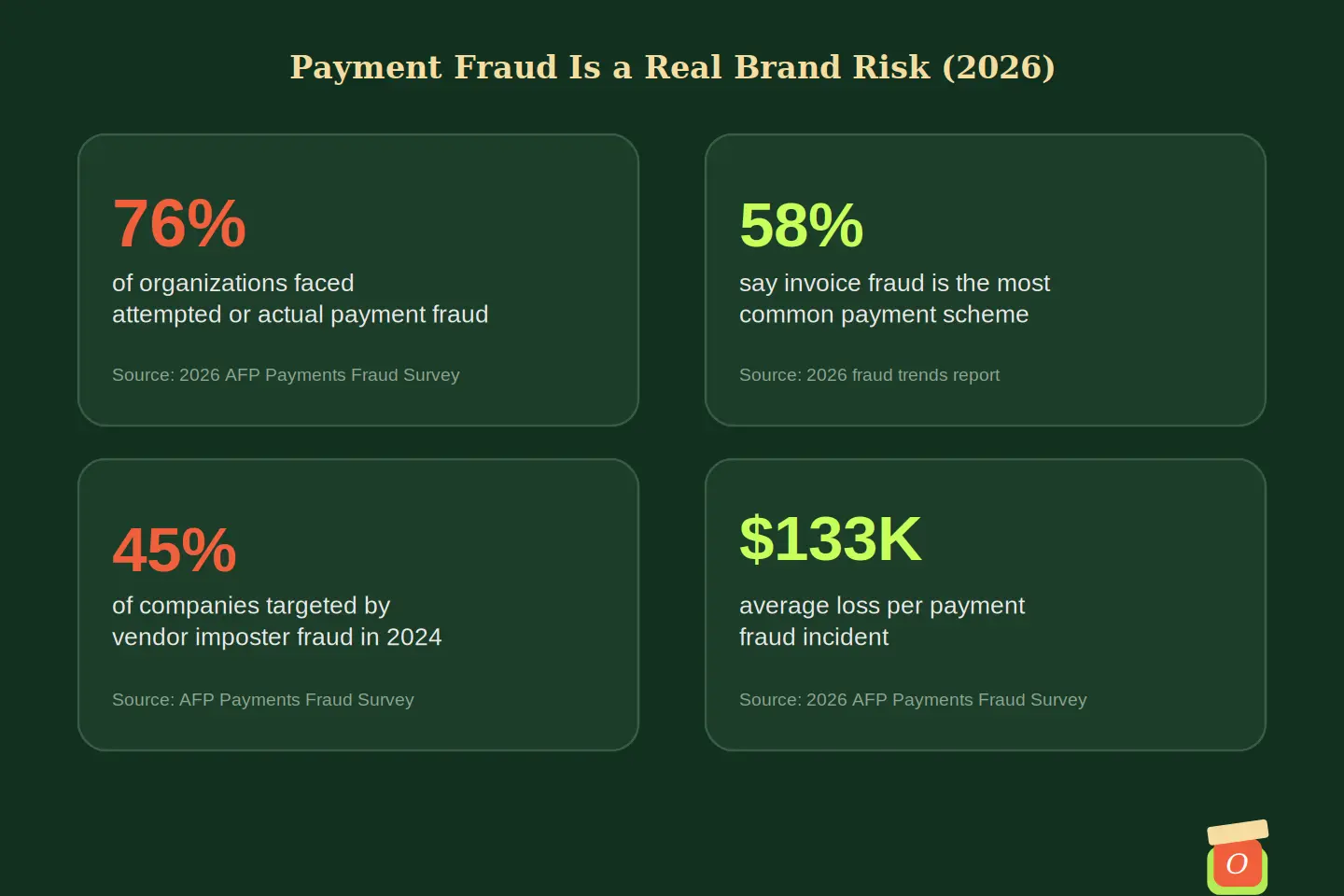
76 percent of organizations faced attempted or actual payment fraud in the past year, with an average loss of $133,000 per incident, according to the 2026 AFP Payments Fraud and Control Survey. Invoice fraud alone was the most commonly reported scheme, cited by 58 percent of organizations, and vendor impersonation attacks jumped to 45 percent of companies targeted in 2024, up from 34 percent the year before. None of this is specific to influencer marketing, but every one of these attack patterns translates directly into the brand-creator payment relationship, often in ways marketing teams never see coming because they assume payment fraud is an accounts-payable problem handled entirely by finance, not something that touches marketing at all.
Learning how secure payments protect brands means understanding the specific fraud patterns that target creator payouts, and the concrete infrastructure, verified bank details, automated release, fraud monitoring, that closes each one. This guide walks through the real risks, how automation and verification reduce them, and how Brand-O-fluence secures every payout by design. By the end, you should be able to spot the exact moment in a payment process where fraud typically slips through, and know precisely what control closes that specific gap. It builds directly on our guide to why escrow is important in influencer marketing, moving from the trust mechanics of escrow into the specific security infrastructure that protects the brand’s side of every transaction.
Table of Contents
- How Secure Payments Protect Brands: More Than a Finance Issue
- Common Payment Fraud Risks Brands Face
- How Automated Payouts Reduce Risk
- How Secure Payments Protect Brand Reputation
- Security Infrastructure That Actually Matters
- How Brand-O-fluence Secures Every Payment
- Step-by-Step: A Secure Payment Setup for Your Brand
- Frequently Asked Questions About How Secure Payments Protect Brands
How Secure Payments Protect Brands: More Than a Finance Issue
Marketing teams tend to treat payment as an administrative afterthought, something finance handles once a creator deal is agreed. That separation is exactly what fraud exploits, since the people closest to a creator relationship are rarely the same people actually approving the payment that relationship depends on.
The Different Ways Brands Lose Money on Payments
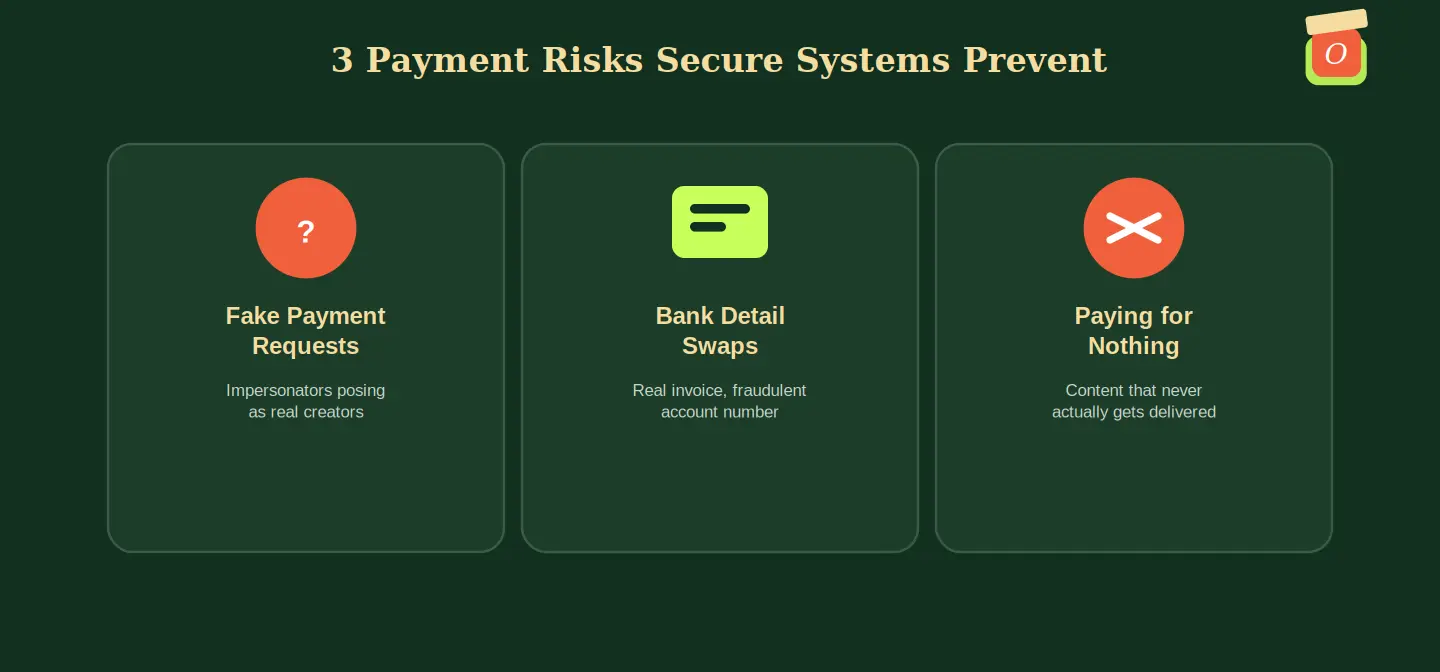
Money disappears in creator payments through several distinct paths: paying an impersonator instead of the real creator, sending funds to a fraudulent bank account after a convincing change request, or simply paying in full for content that never arrives. Each of these is a different failure point, and each needs a different specific safeguard rather than one generic fix that only addresses part of the problem.
Why This Risk Grows With Campaign Volume
A brand running one or two creator partnerships a year can often catch a suspicious request through simple familiarity. That protection disappears once a brand is coordinating dozens of payouts across many creators, since no one on the team knows every relationship well enough to spot something subtly wrong with a request, especially when that request arrives during a busy launch week with several other priorities competing for attention.
Security vs Trust: Two Different Protections
Escrow builds trust between two parties by holding funds neutrally until conditions are met. Payment security is a related but distinct layer, focused on making sure the money actually reaches the right person through the right channel in the first place, regardless of how much either side trusts the other.
Common Payment Fraud Risks Brands Face
These three patterns account for the overwhelming majority of payment fraud brands encounter, whether the target is a supplier, a vendor, or a creator, and each one requires a distinct, specific safeguard rather than a single generic fix.
Fake Creator Payment Requests
An impersonator reaches out claiming to be a creator a brand already has a relationship with, or a well-known creator a brand has never worked with before, requesting payment for content that will supposedly follow. This mirrors classic vendor impersonation fraud almost exactly, just wearing a different costume.
Invoice and Bank Detail Fraud
In the most damaging version of this scheme, the invoice is genuinely from a real creator, and the request looks entirely normal, except the bank account listed for payment has been quietly swapped by whoever intercepted the communication. This is precisely the mechanism behind the vendor bank account fraud responsible for a large share of reported business payment losses, adapted directly to creator payouts.
Paying for Content That Never Delivers
Not every payment loss involves criminal fraud. Sometimes a brand simply pays upfront and a creator, for whatever reason, never delivers the agreed content, leaving the brand with no recourse and no content whatsoever to show for the spend.
How Automated Payouts Reduce Risk
Manual payment processes are where most of this fraud actually succeeds, since a busy employee approving invoices under time pressure is exactly who convincing fraud is designed to fool, and automation removes that pressure point almost entirely.
Removing Manual Bank Transfers
Every manual step in a payment process, someone reading an email, checking a bank detail, initiating a transfer, is a point where a convincing fake can slip through. Automated systems remove several of these manual checkpoints entirely, replacing them with verified data that does not change based on the contents of an incoming email.
Verified Payment Details on File
When a creator’s bank details are verified and locked in at the start of a relationship, a later request to change them becomes something the system flags rather than something an employee has to notice on their own judgment alone. This single control closes off the most damaging version of invoice fraud, the kind where everything except the account number looks completely legitimate.
Consistent Payment Records for Audits
Automated systems generate a clean, timestamped record of every payment tied to a specific deliverable, which matters enormously if a dispute or an audit ever needs to trace exactly what was paid, when, and why. Manual processes rarely produce this same level of consistent documentation across every transaction.
How Secure Payments Protect Brand Reputation
Payment failures do not stay a quiet finance problem. They surface publicly in ways that damage a brand’s standing with creators and audiences alike, often at exactly the moment a brand can least afford the bad press.
Avoiding Public Payment Disputes
Unpaid or disputed creator payments have a way of becoming public complaints, since creators increasingly use their own platforms to call out brands that do not pay fairly or on time. Secure, well-documented payment processes prevent most of these disputes from ever reaching that point.
Maintaining Trust With Creators Long-Term
Word travels fast in creator communities about which brands pay reliably and which ones do not, directly affecting which creators are willing to work with a brand in the future and at what rate. Consistent, secure payments are a quiet but real competitive advantage in negotiating with better creators over time.
Meeting Compliance and Tax Requirements
Proper payment documentation supports the tax and compliance obligations that come with paying creators, including invoicing requirements that regulators increasingly scrutinize as the creator economy formalizes. Skipping this due diligence creates exposure that goes well beyond the original payment itself.
Security Infrastructure That Actually Matters
Not every security feature offers equal protection. These three specifically address the fraud patterns covered earlier in this guide, rather than adding generic-sounding safeguards that do not map to an actual attack vector.
Encrypted Transactions
Payment data moving between a brand, a platform, and a creator should be encrypted at every step, preventing anyone intercepting that communication from reading or altering payment details in transit.
Multi-Step Verification Before Release
Requiring more than one verification step before releasing funds, confirming both the deliverable and the destination account, closes the gap that a single-check process leaves open. This is the direct countermeasure to bank detail swap fraud specifically.
Fraud Monitoring Across Every Payment
Ongoing monitoring for unusual patterns, a sudden change in payment destination, an unusual request timing, or a mismatch between the requester and the verified account holder, catches fraud attempts that a one-time check at account setup would miss entirely.
How Brand-O-fluence Secures Every Payment
Brand-O-fluence was built to close the specific fraud gaps covered in this guide, rather than treating payment security as a generic feature bolted onto the platform as an afterthought.
Automated, Escrow-Backed Payouts
Every payment runs through the same escrow-backed structure covered in our guide on why escrow is important in influencer marketing, combined with automated verification that removes manual bank transfers from the process entirely.
Verified Bank and Tax Details
Creator payment details are verified once and locked into the platform, so any later change request gets flagged for review rather than processed automatically based on an incoming message alone. This directly closes the bank detail swap risk that causes some of the most damaging fraud losses industry-wide.
Built-In Fraud Monitoring
Payment activity is monitored continuously for the kind of unusual patterns covered earlier in this guide, connecting to the same broader verification approach discussed in our guide on why creator verification matters, where identity and ownership checks work alongside payment security to protect both sides of a partnership.
Consider a Nagpur-based electronics brand that received a message appearing to come from a mid-tier tech creator it had worked with twice before, requesting that future payments be sent to a new bank account due to a supposed change in the creator’s business structure. The request looked entirely legitimate, referencing prior campaign details accurately, down to specific product names and posting dates from earlier work together that would have been difficult for a casual impersonator to know. Because the brand’s payment details were locked and verified through Brand-O-fluence, the change request was automatically flagged for manual review rather than processed immediately, and a quick call to the creator’s verified contact confirmed no such request had ever been made. The brand avoided a loss that, based on the campaign’s remaining budget, would have run into several hundred thousand rupees.
Step-by-Step: A Secure Payment Setup for Your Brand
Use this sequence to reduce payment fraud risk across your creator partnerships.
- Verify bank details once, at the start: Confirm and lock a creator’s payment details before the first payment is ever made.
- Require a defined process for any change request: Never update payment details based solely on an email or message without independent confirmation.
- Use escrow for every payment: Route funds through a neutral, conditional structure rather than direct transfers.
- Automate what can be automated: Reduce manual steps where a busy employee could be fooled by a convincing fake.
- Monitor for unusual patterns: Flag sudden changes in payment destination or timing for a closer look before funds move.
- Keep clean, timestamped records: Maintain documentation that supports both disputes and compliance requirements.
Manual Payment vs Secure Automated Payment
The table below compares how these two approaches handle the specific risks covered in this guide.
| Risk Factor | Manual Payment Process | Secure Automated Process |
|---|---|---|
| Bank Detail Changes | Processed based on incoming request | Flagged for independent verification |
| Impersonation Risk | High, relies on employee judgment | Reduced through verified identity checks |
| Payment Documentation | Inconsistent across transactions | Standardized, timestamped records |
| Fraud Monitoring | Rare, ad hoc | Continuous, automated |
| Scalability | Breaks down beyond a handful of creators | Consistent across large creator rosters |
Frequently Asked Questions About How Secure Payments Protect Brands
How common is payment fraud targeting creator payouts specifically?
While most public data on payment fraud covers vendor and supplier relationships broadly, the same tactics, invoice fraud, bank detail swaps, and impersonation, apply directly to creator payments, especially as budgets and the number of active creator relationships grow. Brands running many partnerships at once face meaningfully higher exposure than those working with only one or two creators. The underlying attack patterns are well documented even where creator-specific data is still emerging.
What is the single most effective protection against payment fraud?
Locking verified bank details at the start of a relationship and requiring independent confirmation for any change request closes off the most damaging and common fraud pattern, where a real invoice gets paired with a fraudulent account number. Escrow and automated monitoring add further layers, but this single control addresses the highest-value target for fraudsters, since it is precisely the moment where a legitimate-looking request does the most financial damage. Combining it with the other protections in this guide offers the strongest overall defense.
Does secure payment infrastructure slow down how quickly creators get paid?
Well-designed automated systems typically pay creators faster than manual processes, since verification happens instantly against data already on file rather than requiring a person to manually review every request. The only step that intentionally adds friction is a flagged change request, which is exactly the point where slowing down protects both sides. Routine, unflagged payments move through just as quickly as an unsecured process, often faster.
Is payment security only a concern for large brands with big budgets?
No, smaller brands are frequently targeted specifically because fraudsters assume smaller teams have weaker controls and less capacity to double-check unusual requests. A smaller budget does not mean a smaller consequence relative to that brand’s overall marketing spend. The core protections in this guide apply and matter regardless of company size.
How does payment security relate to creator verification?
The two work together but solve different problems: creator verification confirms who you are dealing with is genuinely who they claim to be, while payment security confirms the money actually reaches that verified party through the correct channel. A brand can verify a creator thoroughly and still lose money to a bank detail swap fraud that has nothing to do with the creator’s own authenticity, since the fraud in that scenario targets the payment channel rather than the creator’s identity. Both protections are necessary, and neither substitutes for the other.
How secure payments protect brands comes down to closing the specific gaps that fraud is designed to exploit: fake payment requests, bank detail swaps, and paying for content that never arrives. Automated verification, locked bank details, and continuous monitoring turn payment from the weakest link in a creator partnership into one of its most reliable protections. As campaign volume grows and more money moves through more creator relationships, this infrastructure stops being optional and becomes the foundation that lets a brand scale its creator program without scaling its risk right alongside it, since the same controls apply consistently whether a brand is paying two creators or two hundred.
If you want every payout protected by design, explore Brand-O-fluence today. Verified bank details, escrow-backed release, and continuous fraud monitoring work together on every single transaction, so your team is not relying on manual judgment calls to catch a convincing fake. Whether you are paying two creators or two hundred, the same protections apply consistently every time. Start paying creators securely on Brand-O-fluence instead of hoping every request that lands in an inbox is exactly what it claims to be.
Leave a Reply