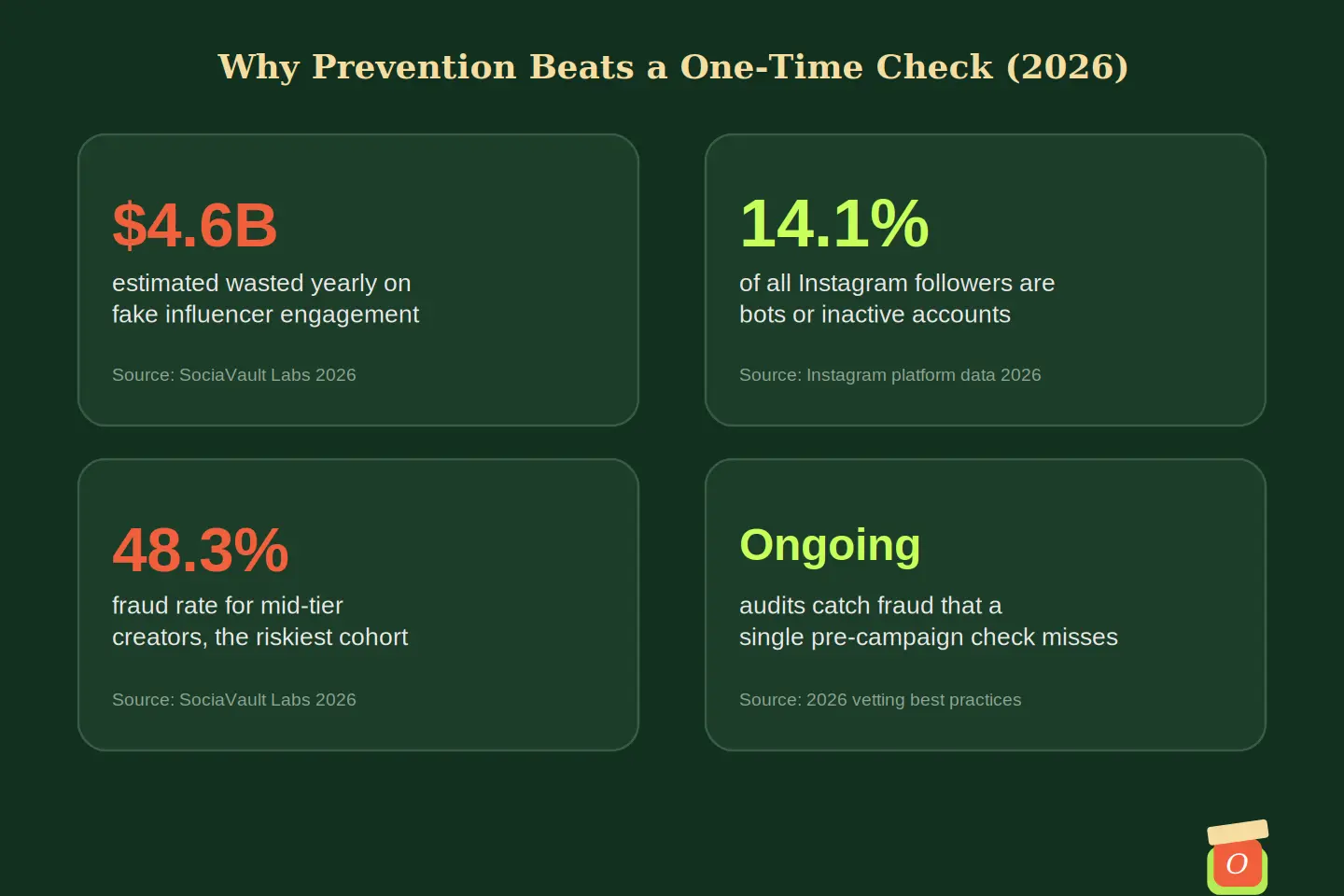
Knowing how to spot a fake follower on a single profile is useful, but it will not protect your brand across dozens of campaigns run by different team members over several years. Fraud researchers estimate that fake and inauthentic engagement wastes roughly $4.6 billion a year industry-wide, a number that keeps climbing because most brands treat fake influencer detection as a one-time check rather than a standing process. A single audit catches a single problem. A real system catches the next one too.
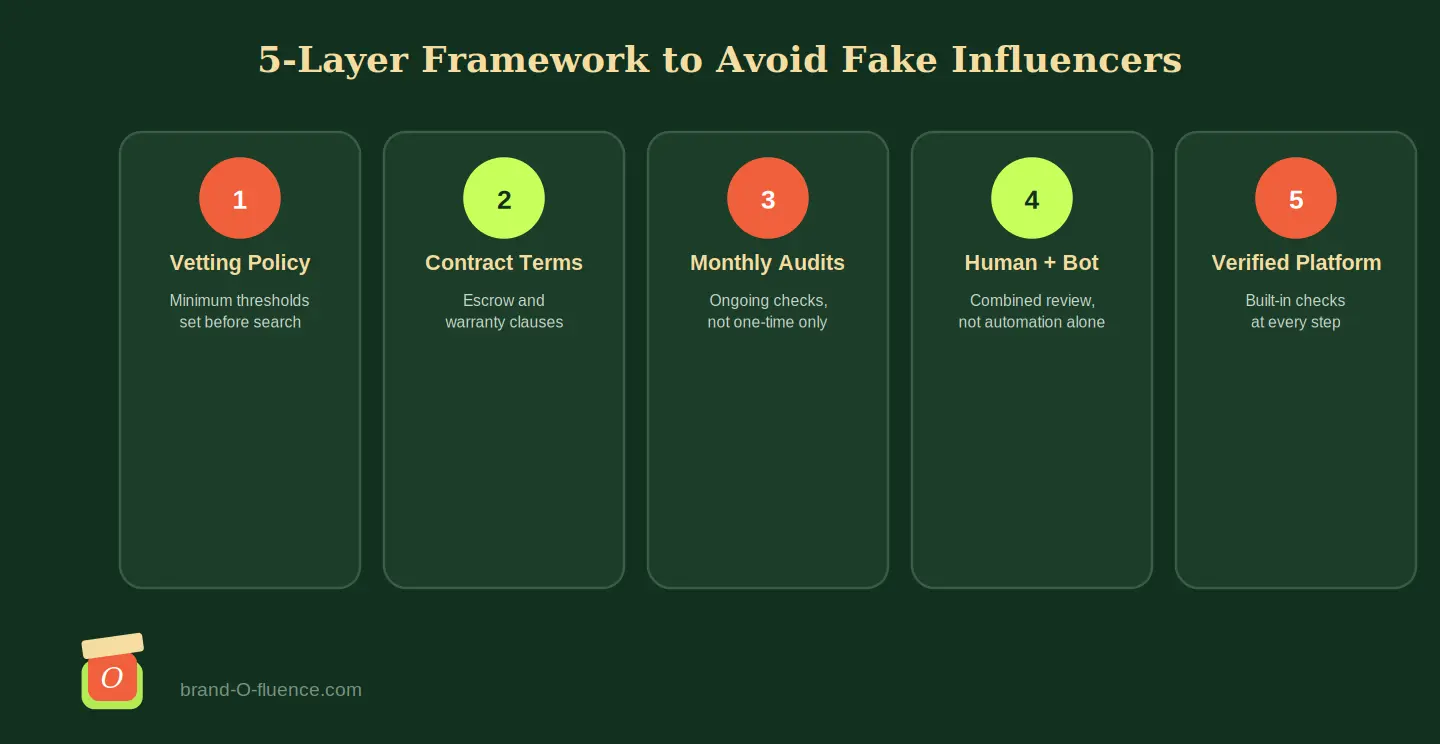
Learning how brands can avoid fake influencers at an organizational level means building policy, contract terms, and ongoing monitoring into how your team works, not just teaching one person to spot red flags. This guide covers the five layers that make up a genuine prevention system, along with how a verified platform like Brand-O-fluence bakes most of this directly into the discovery and campaign process. By the end, you should have a clear picture of what to write down, what to put in every contract, and what to check on a recurring basis, rather than relying on any single team member’s memory. If you have not yet read our guide on how to spot fake Instagram followers, it covers the hands-on detection techniques that feed directly into the process outlined here.
Table of Contents
- How Brands Can Avoid Fake Influencers Beyond a One-Time Check
- Build a Standard Vetting Policy Before You Search
- Protect Your Budget With the Right Contract Terms
- Use Monthly Audits, Not Just Pre-Campaign Checks
- Combine Human Review With Automated Bot Detection
- Choosing a Verified Platform Over Manual Outreach or Agencies
- Step-by-Step: A Fake-Influencer Prevention Checklist for Your Team
- Frequently Asked Questions About How Brands Can Avoid Fake Influencers
How Brands Can Avoid Fake Influencers Beyond a One-Time Check
A single vetting pass before a campaign launches is a good start, but it only protects that one campaign, at that one moment in time. Real prevention has to survive staff turnover, new team members, and creators whose audiences change months after they were first approved. Building that kind of durability is what separates a habit from a system.
Detection Alone Isn’t Prevention
Detection tells you whether a specific creator looks fake right now. Prevention is the system that makes sure every creator gets checked, every time, regardless of who on your team is running the campaign or how much time pressure they are under. Without a standing process, even a team that knows how to spot fake followers will eventually skip a check under deadline pressure.
The Business Risk Beyond Wasted Budget
Fake followers do not just waste ad spend. They distort the data brands use to plan future campaigns, since a fraudulent creator’s inflated numbers get treated as a real benchmark for what “good” looks like. This compounds over time, quietly skewing budget decisions long after the original fake partnership has ended.
Building Avoidance Into Your Process
The goal is to make fraud-checking the default, not an extra step someone has to remember. That means writing down your criteria, putting protective language into contracts, and choosing tools and platforms that check for you automatically rather than relying purely on individual diligence.
Build a Standard Vetting Policy Before You Search
A written policy turns fraud prevention from a personal habit into a team standard that survives even when the person who built it moves to a different role. It also gives new hires something concrete to follow from their very first campaign, instead of learning the standard through trial and error.
Set Minimum Authenticity Thresholds
Decide in advance what minimum engagement rate, follower authenticity score, or audience quality standard a creator needs to meet before your team can approve them. Having this threshold agreed upon before you start searching removes the pressure to make exceptions for a creator who looks impressive but does not actually meet your bar.
Require Verified Analytics, Not Screenshots
Make it a standing rule that no creator gets approved based on a screenshot alone. Verified, platform-sourced data should be the minimum requirement for any campaign above a certain budget threshold, since screenshots can be edited, cropped, or simply outdated by the time anyone reviews them.
Document Your Criteria for Every Campaign
Keep a simple record of why each creator was approved, including the specific metrics that met your policy’s threshold. This documentation matters most when something goes wrong later, giving your team a clear trail to review and improve rather than starting from scratch each time.
Protect Your Budget With the Right Contract Terms
Vetting reduces risk before you sign. Contract terms protect you in case a genuinely authentic-looking creator turns out to have a problem after the fact, which is exactly the scenario a strong vetting policy alone cannot fully prevent.
Escrow and Milestone-Based Payments
Structure payments so funds only release once content is delivered and approved, rather than paying the full amount upfront. This single change removes most of the financial exposure that comes from discovering a fraud problem after a creator has already been paid in full.
Authenticity Warranties and Clawback Clauses
Include language in every contract requiring the creator to warrant that their audience and engagement are authentic, with a clear right for the brand to claw back payment if fraud is discovered afterward. Even if this clause is rarely enforced, it sets an expectation upfront and gives your legal team real leverage if a serious problem surfaces.
Disclosure and Compliance Requirements
Require clear disclosure of sponsored content as part of every agreement, since non-compliant creators are often the same accounts more likely to cut other corners, including inflated follower counts. Building compliance language into contracts protects your brand from regulatory risk at the same time it reinforces overall creator quality.
Use Monthly Audits, Not Just Pre-Campaign Checks
A creator who passed every check before a campaign started can still develop problems weeks or months later, which is exactly why ongoing monitoring matters as much as the initial vetting.
Why Creator Audiences Change Over Time
Follower bases shift constantly, and a creator under financial pressure or chasing a specific brand deal may purchase followers or engagement well after your original approval. Instagram itself removed an estimated 490 million fake accounts in the past year alone, which means even a previously clean creator’s follower base can shift meaningfully within a matter of months.
What a Monthly Audit Should Cover
A lightweight recurring audit should check follower growth trends, engagement rate consistency, and any dramatic shifts in comment quality since the last review. This does not need to be a full manual re-vetting for every creator, but a quick automated check flags the accounts that genuinely need a closer look.
Catching Problems Mid-Campaign
Monthly audits are especially valuable for longer-term ambassador relationships or multi-phase campaigns, where a problem developing partway through can still be caught before the full budget is spent. Waiting until a campaign fully wraps up to check for fraud removes any chance to adjust course while it still matters.
Combine Human Review With Automated Bot Detection
Neither automated tools nor human judgment alone catch everything. The strongest prevention systems use both together, each covering the other’s blind spots, since the mix of scale and context is what fraud actually requires to slip through undetected.
What Automated Detection Catches
Automated tools excel at catching obvious, scalable patterns: sudden follower spikes, high percentages of accounts with no profile photo or posts, and engagement rates that fall outside normal ranges for a given tier. This kind of pattern matching happens instantly and consistently across thousands of profiles, something no human team could realistically do manually.
What Only Human Reviewers Catch
Subtler fraud, like engagement pod coordination or a creator whose content quality has quietly declined despite steady metrics, often needs a trained human reviewer to catch. Context matters here in a way automated systems still struggle with, particularly when a pattern looks unusual but has a legitimate explanation.
Why Neither Approach Works Alone
Automation without human review approves fraud that is clever enough to avoid obvious pattern triggers. Human review without automation cannot possibly scale to check every creator across every campaign a growing brand runs. Combining both is what separates a genuinely reliable prevention process from a checklist that only catches the easy cases.
Choosing a Verified Platform Over Manual Outreach or Agencies
Every layer covered so far, policy, contracts, audits, and combined review, is far easier to maintain consistently when it is built into the platform your team already uses, rather than managed through separate spreadsheets and tools.
The Case for Built-In Verification
When verification lives inside the same platform used for discovery and campaign management, there is no separate step anyone can forget or skip under deadline pressure. This is the same efficiency argument covered in our guide on the benefits of influencer marketing for brands, where verified data consistently drives stronger campaign ROI.
What to Look for in a Verified Platform
Look for platforms that combine automated fraud detection with manual human review, provide verified audience demographics rather than self-reported figures, and support secure, milestone-based payments. A platform missing any one of these three pillars leaves a meaningful gap in your overall prevention system.
How Brand-O-fluence Builds Avoidance Into Every Step
Brand-O-fluence combines automated follower spike detection, manual human review before any profile goes live, ongoing audits rather than one-time checks, and escrow-protected payments in a single platform. This mirrors the exact five-layer framework covered in this guide, so brands do not need to assemble these protections manually across separate tools and vendors.
Consider a Kolkata-based beauty brand that had previously paid a mid-tier creator upfront, only to discover after the campaign that a significant share of the creator’s engagement came from a coordinated pod rather than genuine interest. After the incident, the brand adopted a written vetting policy, moved all payments to escrow, and switched to Brand-O-fluence for discovery and ongoing audits. Over its next six campaigns, the brand caught two additional at-risk creators through routine monthly audits before any budget was committed, avoiding a repeat of its original loss entirely.
Step-by-Step: A Fake-Influencer Prevention Checklist for Your Team
Use this sequence to build or review your own prevention process, regardless of team size.
- Write a minimum vetting policy: Define the authenticity and engagement thresholds every creator must meet before approval.
- Require verified data over screenshots: Make platform-sourced analytics mandatory above a set budget threshold.
- Add authenticity warranties to contracts: Include clawback rights in case fraud is discovered after payment.
- Structure payments through escrow: Release funds only after content is delivered and approved.
- Schedule recurring audits: Set a monthly or quarterly cadence to re-check active creator relationships.
- Combine automated and human review: Use tools for scale and trained reviewers for context and edge cases.
- Choose a platform that builds this in: Reduce reliance on individual diligence by using a system with verification built into every step.
Prevention Approaches Compared
The table below compares three common approaches to avoiding fake influencers.
| Approach | No Formal Process | Manual Vetting Only | Verified Platform with Contracts and Audits |
|---|---|---|---|
| Consistency Across Campaigns | Depends entirely on individual staff | Better, but still person-dependent | Standardized for every campaign |
| Ongoing Monitoring | None | Rare, often skipped under time pressure | Built-in recurring audits |
| Financial Protection | Full upfront payment risk | Depends on contract quality | Escrow-protected by default |
| Scalability | Breaks down beyond a few campaigns | Time-intensive as volume grows | Scales across many campaigns at once |
Frequently Asked Questions About How Brands Can Avoid Fake Influencers
What is the single most effective way to avoid fake influencers?
No single tactic works alone, but combining verified analytics with escrow-based payments closes both the detection gap and the financial exposure gap at the same time. A written vetting policy makes sure this combination gets applied consistently, rather than depending on individual judgment. Ongoing audits then catch problems that develop after a creator has already been approved.
How often should a brand re-check creators it already works with?
A monthly or quarterly audit cadence works well for most brands, balancing thoroughness against the practical effort of ongoing monitoring. Longer-term ambassador relationships benefit from more frequent checks than one-off campaign creators, since more budget and brand reputation are at stake over time. The right frequency ultimately depends on campaign volume and available team resources.
Are contract clauses actually enforceable against fraudulent creators?
Enforceability varies by jurisdiction and the specific wording of the contract, so brands should involve legal counsel when drafting authenticity warranties and clawback language. Even when enforcement is difficult in practice, these clauses still create a documented expectation that can support a clawback request or damage a creator’s reputation with other brands if violated. The clearest financial protection still comes from structuring payments through escrow rather than relying solely on contract enforcement after the fact.
Can smaller brands realistically build this kind of prevention system?
Yes, a written policy and escrow-based payment structure require organizational discipline rather than a large budget, making them accessible to brands of any size. Verified platforms extend this further by handling the automated and manual review layers, which would otherwise be difficult to build independently. Prevention scales down just as well as it scales up, since the core principles stay the same regardless of campaign volume.
Does avoiding fake influencers mean avoiding larger creators entirely?
No, larger creators can still be genuinely authentic, and avoiding them entirely would remove valuable reach from a brand’s overall strategy. The data does suggest applying extra scrutiny to mid-tier and macro creators specifically, since this segment has shown higher fraud rates in recent industry studies. A consistent vetting process applied to every creator, regardless of size, is a better strategy than avoiding an entire tier outright.
Learning how brands can avoid fake influencers comes down to building a system that does not depend on any one person remembering to check. A written vetting policy sets the standard, contract terms protect your budget when something slips through, monthly audits catch problems that develop after approval, and combined human and automated review closes gaps neither approach handles alone. Brands that build all five layers into how they work consistently spend their creator budgets on partnerships that actually deliver, and they spend far less time cleaning up after the ones that do not.
If you want this entire framework built into one platform, explore Brand-O-fluence today. Automated detection, manual review, ongoing audits, and escrow-protected payments all work together by default, so your team does not have to assemble prevention from separate tools and spreadsheets. Whether you are running one campaign a quarter or managing dozens of creator relationships at once, the same protections apply consistently. Start protecting your influencer budget on Brand-O-fluence instead of hoping a one-time check was enough.
Leave a Reply