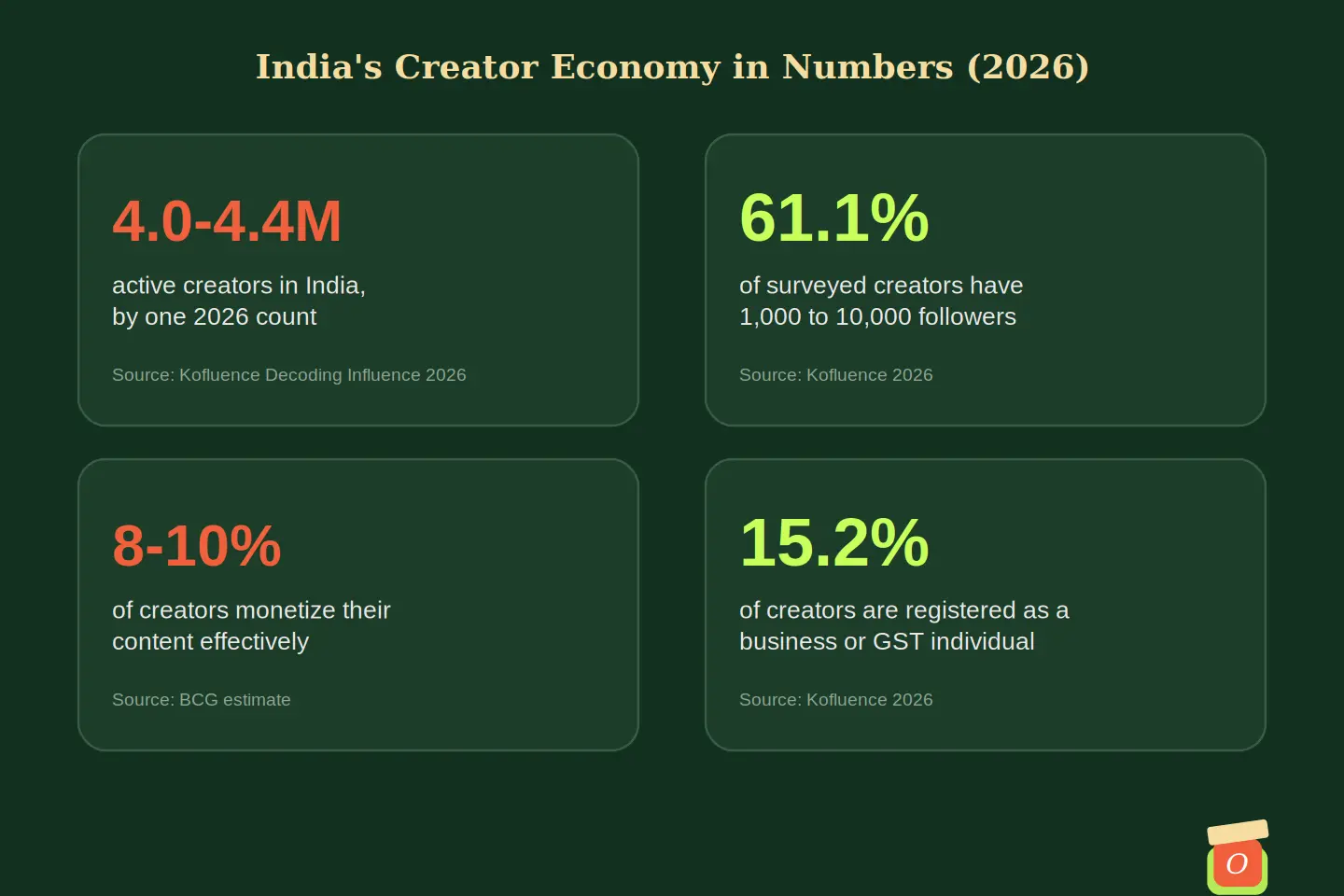
In one 2026 survey of Indian creators, 61.1 percent had between 1,000 and 10,000 followers, and only 15.2 percent were registered as a business or GST individual. Those two facts say a lot about the creator economy in India: it is huge, young, and made up mostly of small creators who are still building the paperwork, pricing, and payment habits of a real industry. At the same time, EY puts India’s influencer marketing market at INR 3,375 crore in 2026, so the money is clearly flowing.
This guide looks at the creator economy in India from a brand’s point of view: which platforms matter, why regional creators are rising, who actually earns, how brand collaborations work, and where trust and payments still break down. It also shows how AI matching and verified marketplaces such as Brand-O-fluence fit into the picture. If you need a plain definition first, start with our guide on what is the creator economy.
Table of Contents
- The Creator Economy in India: The Big Picture
- Platforms Driving the Creator Economy in India
- Regional and Vernacular Creators
- Who Actually Earns in India’s Creator Economy
- Brand Collaborations: How the Money Flows
- The Challenges: Trust, Payments, and Compliance
- AI Matching and Verified Marketplaces
- Step-by-Step: What Brands and Creators Should Do Next
- Frequently Asked Questions About the Creator Economy in India
The Creator Economy in India: The Big Picture
India is one of the largest creator markets in the world, driven by cheap mobile data, a young population, and a very large base of social media users. Before looking at details, it helps to see the scale and the caveats around it.
How Big It Is
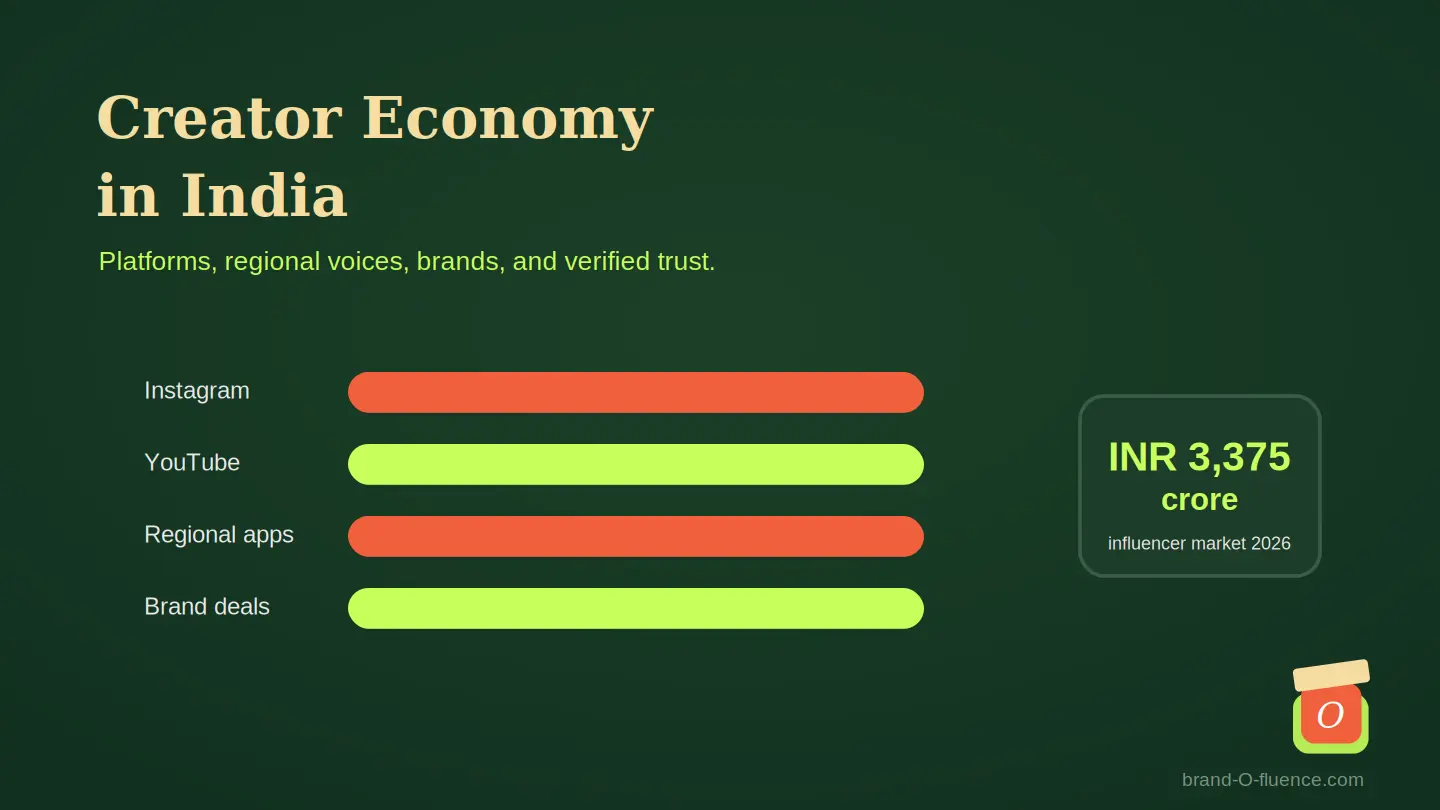
EY estimates India’s influencer marketing market at INR 3,375 crore in 2026, roughly 400 million US dollars, with double-digit growth. Different reports quote growth rates from about 18 percent to 25 percent a year. One market report values the wider Indian creator economy near 15 billion US dollars, but other sources use narrower definitions and arrive at far smaller totals.
How Many Creators There Are
Counts depend on the definition. BCG estimates roughly 2 to 2.5 million creators who monetize their content, and the government has cited a similar range. Kofluence’s 2026 report counts 4.0 to 4.4 million active creators, and looser estimates reach tens of millions when they include everyone who posts regularly. Plan around the narrower, earning-creator numbers, since those are the people brands actually hire. Even the conservative count of 2 to 2.5 million earning creators is large enough to find a strong match in almost any niche or city.
Why It Keeps Growing
More Indians come online every year, and short video has made it easy for anyone to publish. Brands have noticed that creator content often earns more trust and engagement than polished advertising, and that it costs far less than a television or print campaign. Our guide on the future of influencer marketing in India covers the market trends behind this growth in more detail.
Platforms Driving the Creator Economy in India
Creators in India work across several platforms, and each plays a different role in a brand’s plan.
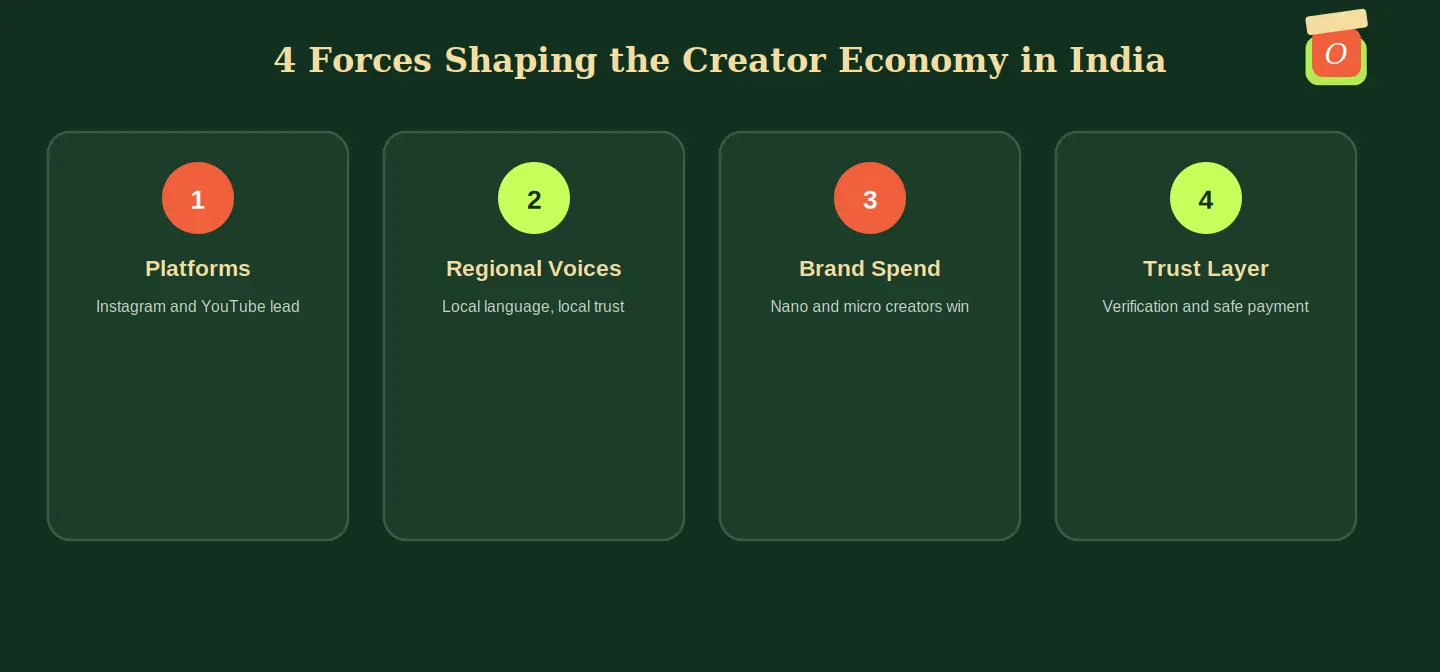
Instagram is the main brand-collaboration platform. Kofluence’s 2026 report puts 3.3 to 3.7 million of India’s active creators on Instagram, and the country is widely described as the platform’s largest user market. Reels, Stories, and product tags make it the default choice for D2C, fashion, beauty, food, and lifestyle brands.
YouTube
YouTube suits longer reviews, tutorials, and explainers. One market report notes that more than 100 million Indian channels uploaded content in a recent year, and over 15,000 channels have passed one million subscribers. For categories where buyers research before they purchase, such as electronics, finance, and education, YouTube creators carry real weight.
Short Video and Regional Apps
Regional and short-video platforms give creators in smaller cities a way to reach local audiences in their own language. Many creators publish on several platforms at once, so brands should look at a creator’s full presence rather than a single account. A creator who is modest on Instagram may be strong on YouTube Shorts or a regional app, and the best campaigns often use more than one channel.
Regional and Vernacular Creators
Some of the fastest growth in the creator economy in India is happening outside English and outside the big metros.
Why Language Matters
Hindi, Tamil, Telugu, Bengali, Marathi, Gujarati, Kannada, and many other languages each have their own creator communities. A recommendation in a viewer’s first language feels more personal, and it often explains a product better than a translated ad. Our earlier research found that many creators now receive more region-specific briefs from brands than before.
Tier 2 and Tier 3 Cities
Creators in cities such as Indore, Coimbatore, Nagpur, Guwahati, and Bhubaneswar often have audiences concentrated in one place. For a brand with local delivery or growing distribution there, that overlap is valuable, because every follower is a realistic customer. These creators also tend to charge less, since their audiences are smaller. They are often the first to try a new product in their city, which gives local brands an early advantage over national competitors who have not reached these markets yet.
What This Means for Brands
Brands that search only in Mumbai, Delhi, and Bengaluru miss a large share of potential customers. Filtering by city and language during creator discovery opens up a wider, more affordable pool. Our guide on how nano creators beat celebrity influencers explains why these small, local voices often convert better than famous names.
Who Actually Earns in India’s Creator Economy
Having a large number of creators does not mean most of them earn a living. The gap between creators and earners is one of the defining features of the creator economy in India.
The Monetization Gap
BCG estimates that only 8 to 10 percent of creators in India monetize their content effectively, and other surveys suggest that fewer than five percent earn their main income from content. Most creators earn little or nothing, often because brand demand is inconsistent and payment is unreliable. Many also lack the media kits, analytics, and pricing confidence needed to win steady work, which is exactly where a verified profile with real data can help.
Concentration at the Top
One 2026 estimate suggests the top one percent of creators capture around 70 to 75 percent of influencer marketing revenue. Treat that figure as a rough guide, since estimates differ, but the pattern matches other creator economies: a few very large accounts take most of the money, while a long tail earns modest amounts.
A Base of Nano and Micro Creators
Kofluence’s survey found that 61.1 percent of creators sit in the 1,000 to 10,000 follower tier. One estimate puts Indian micro creators at 3 to 5 percent engagement, well above many global averages. For brands, this long tail is an opportunity, because small creators often deliver strong engagement at low cost, as shown in our guide on why micro influencers deliver better ROI.
Brand Collaborations: How the Money Flows
For most creators, brand collaborations are the first and largest source of income, so understanding how these deals work helps both sides.
What Creators Typically Charge
Industry estimates put nano Reel rates at roughly 3,000 to 8,000 rupees and micro Reel rates at 8,000 to 25,000 rupees, with higher tiers charging much more. Rates vary by niche, format, and usage rights, so always confirm what a quoted fee includes. Ask whether the price covers revisions, Stories, reposting on brand channels, and how long the content may be used in ads.
Payment Terms and Delays
Net-30 and Net-60 payment terms remain common, and one industry survey found that around 42 percent of micro-influencers have faced delays or non-payment. For a creator earning a few thousand rupees per post, a late payment is a real hardship. This is why safe, conditional payment matters so much, as covered in our guide on why escrow is important in influencer marketing.
Formalization and Tax
Only about 15 percent of creators are registered as a business or GST individual, but that is changing. Rules on tax deducted at source for creator payments, covered in our earlier India guide, push more creators toward formal invoicing. Brands that work with creators who can issue proper invoices find audits and reporting much easier. Creators who formalize early also look more professional, which helps them win larger and more regular campaigns.
The Challenges: Trust, Payments, and Compliance
The creator economy in India has grown faster than its infrastructure. Three gaps cause most of the friction.
Fake Followers and Weak Verification
A 2026 study of 100,000 accounts found that 37.2 percent of influencer followers showed signs of being fake or inauthentic. Brands that pick creators by follower count alone pay for reach that does not exist. Our guide on how to spot fake Instagram followers covers the checks that catch most of it.
Unsafe Payments
Brands worry about paying upfront for content that never arrives, and creators worry about delivering work that never gets paid. Without a neutral structure, both sides are exposed. Escrow-based release solves most of this. Funds sit safely until the agreed work is confirmed, so neither side has to trust the other blindly.
Disclosure and Compliance
India’s advertising regulator has reviewed more than 1,600 influencer-related violation cases in a single year, most of them involving weak disclosure. Brands should confirm disclosure before any content goes live, since fixing it afterward is slower and more public. A simple checklist item in every brief, covering labels and claims, prevents most of these problems.
AI Matching and Verified Marketplaces
With millions of creators and limited time, brands need better ways to find the right ones. Two developments are changing how this works.
AI Creator Matching
AI tools can filter thousands of profiles by niche, city, language, and audience data in minutes. Industry surveys show that a growing share of creators already use AI for ideation and scheduling, and brands increasingly use it for discovery. Human review still matters for judgment calls, which is why the best systems combine both. A tool can shortlist fifty creators in seconds, but a person is better placed to judge whether a creator’s tone and style truly suit your brand.
Verified Creator Marketplaces
A verified marketplace confirms identity, account ownership, and audience quality before a creator is listed. This removes much of the manual checking brands do today and gives smaller teams the same protection that large agencies build for themselves. Brand-O-fluence is built this way, combining automated screening with human review, as explained in our guide on why creator verification matters.
One Workflow From Brief to Payment
Beyond discovery, the platform handles briefs, contracts, content review, escrow-protected payment, and verified analytics in one place. That structure helps small teams run many creator partnerships without drowning in admin. It also gives creators a single place to see briefs, deadlines, and payment status, which builds the kind of trust that keeps good creators coming back.
Consider a Madurai-based jewelry brand that wanted to reach Tamil-speaking customers in Coimbatore and Salem. It used Brand-O-fluence to shortlist fifteen verified creators between 6K and 40K followers who posted in Tamil and lived in those cities. Contracts and escrow were set up within a week, each creator received a unique order code, and the brand tracked which partnerships brought in orders. It kept the six best performers for its festival campaign, and every creator was paid as soon as their content was confirmed live.
Step-by-Step: What Brands and Creators Should Do Next
Whether you are hiring creators or becoming one, these steps help you build on solid ground.
- Start with a clear goal: Brands choose awareness, engagement, or sales. Creators decide which partnerships they want.
- Look beyond the metros: Search for creators in Tier 2 and Tier 3 cities who speak your customers’ language.
- Prefer verified profiles: Check identity, audience location, and engagement quality before any deal.
- Mix creator tiers: Put most of the budget into nano and micro creators, with a smaller share for reach.
- Put every deal in writing: Include deliverables, deadlines, usage rights, disclosure, and payment terms.
- Pay through escrow: Fund the deal first and release payment when content is confirmed live.
- Track results by creator: Rehire the creators who deliver, and keep clean invoices and records.
Traditional Route vs Verified Marketplace
The table below compares how brands in India typically work with creators today against a verified marketplace approach.
| Factor | Traditional Route (DMs, Agencies) | Verified Marketplace |
|---|---|---|
| Creator Discovery | Manual search or agency rosters | Filters by niche, city, language, and follower range |
| Regional Reach | Often focused on metros | Includes Tier 2 and Tier 3 creators |
| Verification | Screenshots and self-reported data | Identity, ownership, and audience checks |
| Payment | Upfront or Net-30 to Net-60 | Escrow released on verified delivery |
| Paperwork | Handled by hand, often inconsistent | Contracts and invoicing inside the platform |
| Time to Launch | Several weeks | Often under a week |
Frequently Asked Questions About the Creator Economy in India
How big is the creator economy in India?
EY puts India’s influencer marketing market at INR 3,375 crore in 2026, roughly 400 million US dollars. Broader estimates of the full creator economy are much larger but depend heavily on what they count. Check each report’s definition before comparing figures, and treat any single number as a rough guide rather than a precise count.
How many creators are there in India?
Estimates range widely. BCG counts roughly 2 to 2.5 million monetizing creators, while Kofluence reports 4.0 to 4.4 million active creators. Looser counts that include every regular poster reach tens of millions.
Do most Indian creators earn a living from content?
No. BCG estimates that only 8 to 10 percent of creators monetize effectively, and other surveys put full-time earners below five percent. Inconsistent brand demand and late payments are the main reasons.
Why are regional creators important for brands?
Regional creators speak their audience’s first language and often live in the same city as their followers. That makes recommendations feel personal and helps brands reach customers in Tier 2 and Tier 3 cities. They also tend to charge less than metro creators.
How can brands work with creators safely in India?
Choose verified creators, put deliverables and disclosure terms in writing, and pay through escrow so funds release only after delivery. A verified marketplace builds these steps into one workflow. This protects your budget and keeps creators paid on time.
The creator economy in India is large, young, and growing quickly, but it is also uneven. Most creators are small, most earn little, and many still face unreliable payment, weak verification, and unclear paperwork. Brands that look beyond the metros, work with nano and micro creators, and insist on verified profiles and safe payment will get the best results while helping the industry mature. Creators who build verified profiles, price fairly, and keep clean records will be first in line for the steady work that most of the industry still lacks.
If you want to work with India’s creators on solid ground, explore Brand-O-fluence today. Find verified creators by niche, city, and language, run campaigns in one workflow, and pay safely through escrow. Start your next campaign on Brand-O-fluence and tap into the creator economy in India with confidence.
Leave a Reply