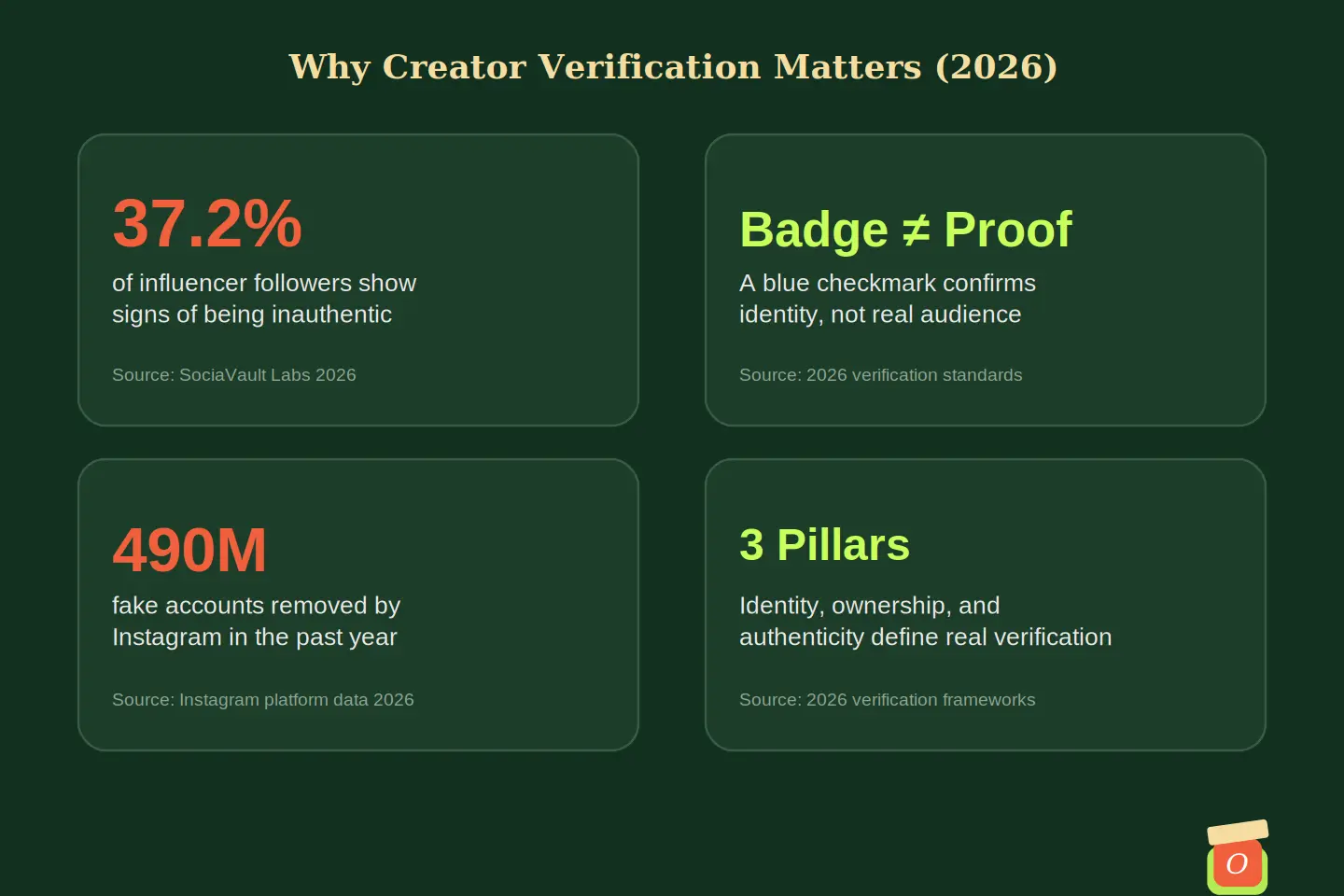
A blue checkmark next to a creator’s name confirms exactly one thing: the platform believes a real person or entity controls that account. It says nothing about whether their followers exist, whether their engagement is genuine, or whether the person behind the account is actually who they claim to be in their content. As AI-generated personas and deepfake technology get harder to distinguish from real creators, understanding why creator verification matters has become essential, not optional, for any brand planning a partnership.
This guide breaks down what real creator verification actually involves beyond a platform badge, why it matters for both brand safety and campaign ROI, and what a thorough verification process should include before any brand signs a contract. It also covers how Brand-O-fluence verifies identity, ownership, and authenticity for every creator before they ever appear in search results. By the end, you should be able to tell the difference between a badge that looks reassuring and verification that actually protects your budget. This builds on the fraud-prevention groundwork covered in our guide on how brands can avoid fake influencers, focusing specifically on the verification layer that underpins the entire system.
Table of Contents
- What Does Creator Verification Actually Mean?
- Why Creator Verification Matters for Brand Safety
- The Business Case: Why Creator Verification Matters for ROI
- What a Real Verification Process Should Include
- Why Creator Verification Matters More With AI-Generated Influencers
- How Brand-O-fluence Verifies Every Creator Before Listing
- Step-by-Step: What to Check Before Trusting a Verified Badge
- Frequently Asked Questions About Why Creator Verification Matters
What Does Creator Verification Actually Mean?
Verification gets used loosely across the industry, often meaning very different things depending on who is using the word. Getting specific about what it should mean is the first step toward actually protecting your brand, rather than assuming a single badge covers every possible risk.
Identity Verification vs Follower Verification
Identity verification confirms who is behind an account, while follower verification confirms whether that account’s audience is real. These are two entirely separate checks, and a creator can pass one while failing the other completely. A well-known, clearly identified creator can still have a heavily inflated follower count, just as an anonymous account can occasionally have a genuinely engaged audience.
Confirming Account Ownership
Ownership verification proves that the person or team you are negotiating with actually controls the account in question, rather than someone impersonating a popular creator or acting without real authority to make deals on their behalf. This step alone prevents a surprisingly common and costly mistake: paying an impersonator who never delivers any content at all.
Why Verification Is Different From Fraud Detection
Fraud detection looks for signs that something is wrong, like fake followers or bot engagement. Verification is proactive, confirming upfront that a creator’s identity, ownership, and audience meet a standard before any red flags even need to be checked. Strong verification reduces how much fraud detection work is needed later, since problem accounts get filtered out before they ever reach a brand’s search results, saving marketing teams from repeating the same manual checks on every single campaign.
Why Creator Verification Matters for Brand Safety
Brand safety has expanded well beyond avoiding offensive content. In 2026, it increasingly includes confirming that the creators a brand partners with are exactly who and what they claim to be, since reputational and financial risk both trace back to that same basic question.
Accountability When Something Goes Wrong
If a sponsored post causes controversy or a creator violates the terms of a contract, verified identity makes it possible to hold the right party accountable. An unverified or anonymous account offers no such recourse at all, leaving a brand with limited options if a partnership goes badly.
Avoiding Impersonation and Account Takeovers
Impersonation is a real and growing risk, with bad actors creating lookalike profiles or gaining unauthorized access to legitimate accounts to solicit brand deals they have no right to negotiate. Ownership verification closes this gap directly, confirming that the account you are speaking with is genuinely controlled by the creator it claims to represent.
Protecting Contracts and Payments
A contract is only as strong as your ability to confirm who actually signed it and who actually controls the account delivering on its terms. Verified identity gives contracts real teeth, since enforcement and dispute resolution depend on being certain of who you are actually dealing with.
The Business Case: Why Creator Verification Matters for ROI
Beyond risk reduction, verification has a direct and measurable connection to campaign performance and long-term marketing efficiency.
Verified Creators Convert Trust Into Sales
Audiences increasingly respond to authenticity signals, and a creator whose identity and audience are genuinely verified tends to carry more credibility with their own followers. That credibility transfers directly to any brand message the creator shares, making verified partnerships a stronger foundation for conversion-focused campaigns.
Reducing Wasted Outreach
Every hour spent negotiating with an account that turns out to be fake, impersonated, or backed by an inauthentic audience is an hour not spent on a partnership that could have actually worked. Verification upfront filters out these dead ends before they consume a marketing team’s limited time and attention.
Building Long-Term Creator Relationships
Verified creators are easier to build repeat partnerships with over time, since both sides have already established real identity and accountability. This foundation makes renegotiating future campaigns faster and reduces the due diligence needed for every subsequent deal with the same creator.
What a Real Verification Process Should Include
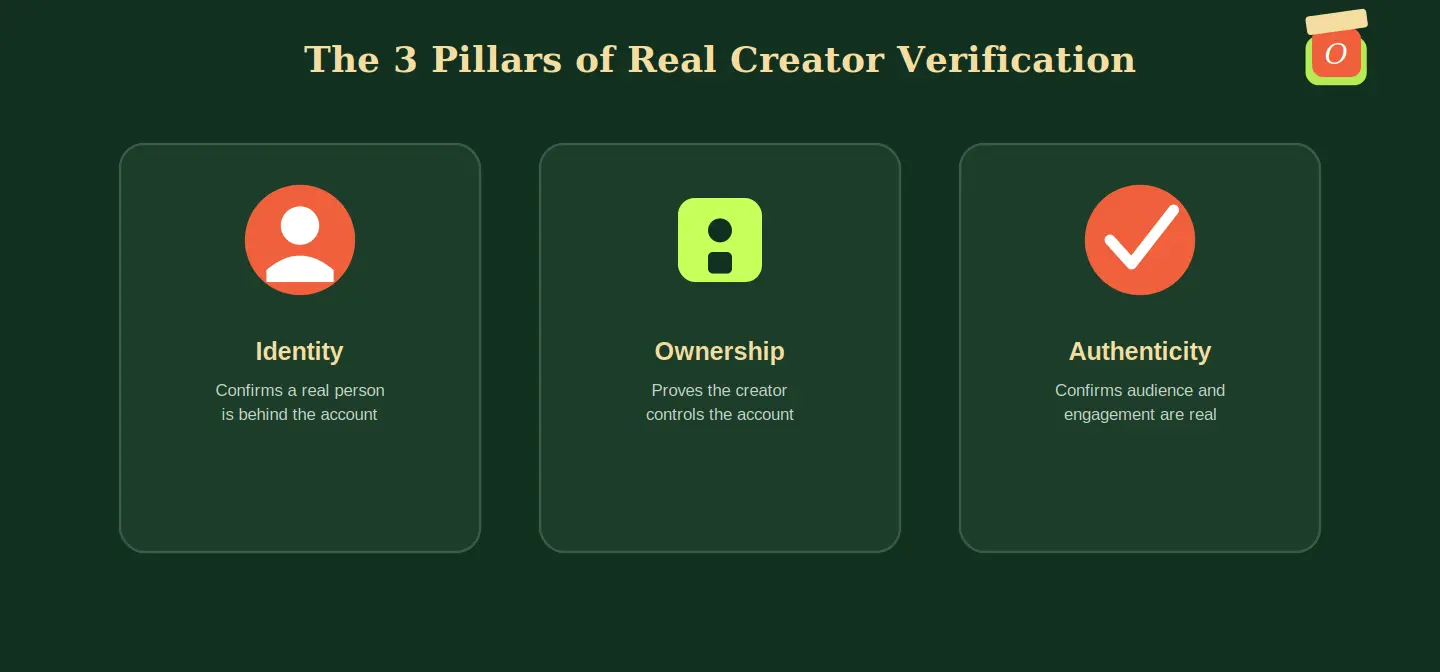
A genuinely thorough verification process covers three distinct layers, each addressing a different kind of risk.
- Identity confirmation: Verifying the real person or entity behind an account through documentation or platform-level identity checks.
- Ownership checks: Confirming the account is genuinely controlled by the creator claiming to represent it, not an impersonator or unauthorized third party.
- Engagement and audience review: Checking that followers and engagement reflect a real, active audience rather than bots or purchased growth.
Government ID or Identity Confirmation
Some platforms require government-issued identification or equivalent documentation before granting verified status, creating a much stronger identity standard than a simple email confirmation. This step matters most for higher-budget campaigns, where the cost of an impersonation or fraud incident would be significant.
Platform Ownership Checks
Ownership checks typically confirm that the person negotiating a deal has administrative access to the account in question, sometimes through platform-level API access or direct verification with the social media platform itself. This prevents a common scam where someone claims to represent a creator without actually having any real authority to do so.
Engagement and Authenticity Review
The final layer examines whether a creator’s audience behaves like a real, engaged community, looking at comment quality, follower growth patterns, and engagement consistency across posts. This is the layer most closely tied to the fake follower detection techniques covered in our guide on how to spot fake Instagram followers, applied systematically rather than case by case.
Why Creator Verification Matters More With AI-Generated Influencers
Synthetic and AI-generated creator personas add an entirely new dimension to verification that did not exist just a few years ago, and the pace of change here means brands cannot rely on the same assumptions that worked even two or three years back.
Why Synthetic Creators Are a Growing Risk
Industry reports in 2026 increasingly flag fully synthetic influencer personas, AI-generated identities with no real person behind them at all, as an emerging brand safety concern. These accounts can produce convincing content and build genuine-looking follower bases, without any real individual accountable for what gets posted or promised in a brand deal.
How Verification Catches Fabricated Identities
Identity confirmation is specifically designed to catch this problem, since a fully synthetic persona cannot pass genuine identity documentation checks the way a real creator can. Platforms and brands that skip this layer of verification are the most exposed to signing a contract with an entity that was never a real person to begin with.
What Brands Should Ask Before Signing
Before finalizing any partnership, ask directly whether a creator’s content involves AI-generated elements and confirm this through independent verification rather than taking a claim at face value. Brands should also build contract language that addresses AI disclosure specifically, since liability and audience expectations differ meaningfully between a real creator and a synthetic one.
How Brand-O-fluence Verifies Every Creator Before Listing
Brand-O-fluence treats verification as a prerequisite for being listed at all, rather than an optional add-on brands have to request separately.
Identity and Ownership Verification
Every creator on the platform goes through identity confirmation and account ownership checks before their profile becomes searchable, closing the impersonation and synthetic-persona risks covered earlier in this guide. This upfront filtering is what allows brands to search with confidence instead of manually verifying every single profile themselves.
Engagement and Authenticity Review
Beyond identity, every profile is reviewed for engagement quality and audience authenticity before listing, combining automated pattern detection with manual human review. This connects directly to the broader prevention framework covered in our guide on how brands can avoid fake influencers, where this kind of upfront filtering is one of five layers that make real prevention possible.
Ongoing Re-Verification
Verification does not end once a profile goes live. Creators are periodically re-checked to confirm their identity, ownership, and audience quality remain consistent over time, since accounts can change hands or develop authenticity problems well after their initial approval.
Consider a Mumbai-based fashion label that was approached directly on Instagram by an account claiming to represent a well-known regional creator, offering a steep discount for a rushed campaign timeline that created obvious pressure to skip due diligence. Before responding, the brand’s team cross-checked the account through Brand-O-fluence and found no match to the creator’s verified profile on the platform, confirming the outreach came from an impersonator rather than the genuine creator. The brand avoided sending any payment and later connected with the real creator’s verified profile directly, completing a legitimate campaign at a fair, standard rate instead.
Step-by-Step: What to Check Before Trusting a Verified Badge
Use this sequence any time a creator’s verified status is part of your decision to move forward with a partnership.
- Confirm what the badge actually certifies: Check whether it verifies identity only, or identity plus audience authenticity.
- Cross-check account ownership: Confirm the person negotiating the deal genuinely controls the account in question.
- Review engagement independently: Do not treat a verification badge as a substitute for checking real engagement quality.
- Ask about AI-generated content directly: Confirm whether any part of a creator’s persona or content involves synthetic elements.
- Check for recent ownership changes: Look for signs an account may have changed hands since it was originally verified.
- Use a platform with layered verification: Prefer platforms that combine identity, ownership, and authenticity checks over a single badge alone.
Verification Levels Compared
The table below compares what different levels of “verification” actually confirm.
| Verification Level | What It Confirms | What It Misses |
|---|---|---|
| No Verification | Nothing independently confirmed | Identity, ownership, and audience quality |
| Platform Badge Only | Basic identity or notability | Audience authenticity and current ownership |
| Self-Reported Media Kit | Whatever the creator chooses to share | Independent confirmation of any figure shown |
| Brand-O-fluence Verified Profile | Identity, ownership, and authenticity together | Re-checked periodically to stay current |
Frequently Asked Questions About Why Creator Verification Matters
Is a platform’s blue checkmark enough verification for a brand deal?
No, a platform badge typically confirms identity or notability alone, without independently verifying audience authenticity or current account ownership. Brands should treat a blue checkmark as one data point rather than complete proof that a partnership is safe. Additional checks on engagement quality and ownership remain necessary even when a creator appears verified on their platform.
How does creator verification protect against impersonation?
Ownership verification specifically confirms that the person negotiating a deal actually controls the account in question, which directly prevents a common scam where someone falsely claims to represent a well-known creator. Cross-checking outreach against a creator’s verified profile on a trusted platform is one of the fastest ways to catch this kind of impersonation before any money changes hands. This step matters most when a brand is approached directly rather than initiating contact themselves, since inbound outreach with unusually generous terms is a common pattern in impersonation attempts.
Can an AI-generated influencer ever be properly verified?
A fully synthetic persona cannot pass genuine identity documentation checks in the same way a real person can, which is exactly why identity verification is an effective filter against this risk. Some creators do disclose AI involvement transparently while still maintaining a genuine underlying identity, which is a different and generally lower-risk situation. Brands should ask directly and confirm independently rather than assuming a polished profile is automatically a real person.
Does verification guarantee a campaign will perform well?
No, verification confirms that a creator and their audience are genuinely real, but it does not guarantee content quality, creative fit, or campaign performance on its own. Verification should be treated as a baseline requirement, not a complete evaluation, alongside the broader selection criteria covered in choosing the right creator for a specific campaign. A verified but poorly matched creator can still underperform for reasons unrelated to authenticity.
How often should creator verification be refreshed?
Ongoing or periodic re-verification is important, since account ownership and audience composition can both change after an initial check. A creator verified a year ago may have since sold their account, experienced a takeover, or seen a meaningful shift in audience quality. Platforms that build in recurring re-verification offer stronger, more current protection than a single point-in-time check.
Understanding why creator verification matters comes down to a simple distinction: a platform badge tells you almost nothing on its own, while genuine identity, ownership, and authenticity checks together tell you whether a partnership is actually safe to pursue. As AI-generated personas and impersonation schemes grow more sophisticated, this layered approach to verification is becoming a baseline requirement rather than an optional extra step. Brands that build verification into every partnership protect both their budget and their reputation from risks that a quick glance at a profile would never reveal, and they spend far less time untangling problems that proper verification would have caught early.
If you want every creator pre-verified before you even start searching, explore Brand-O-fluence today. Identity, ownership, and authenticity are confirmed for every profile before it goes live, and ongoing re-checks keep that protection current over time. Whether you are negotiating your first creator partnership or managing a roster of dozens, the same verified foundation applies to every profile you search. Start working with genuinely verified creators on Brand-O-fluence instead of relying on a badge that may not mean what you think it does.
Leave a Reply