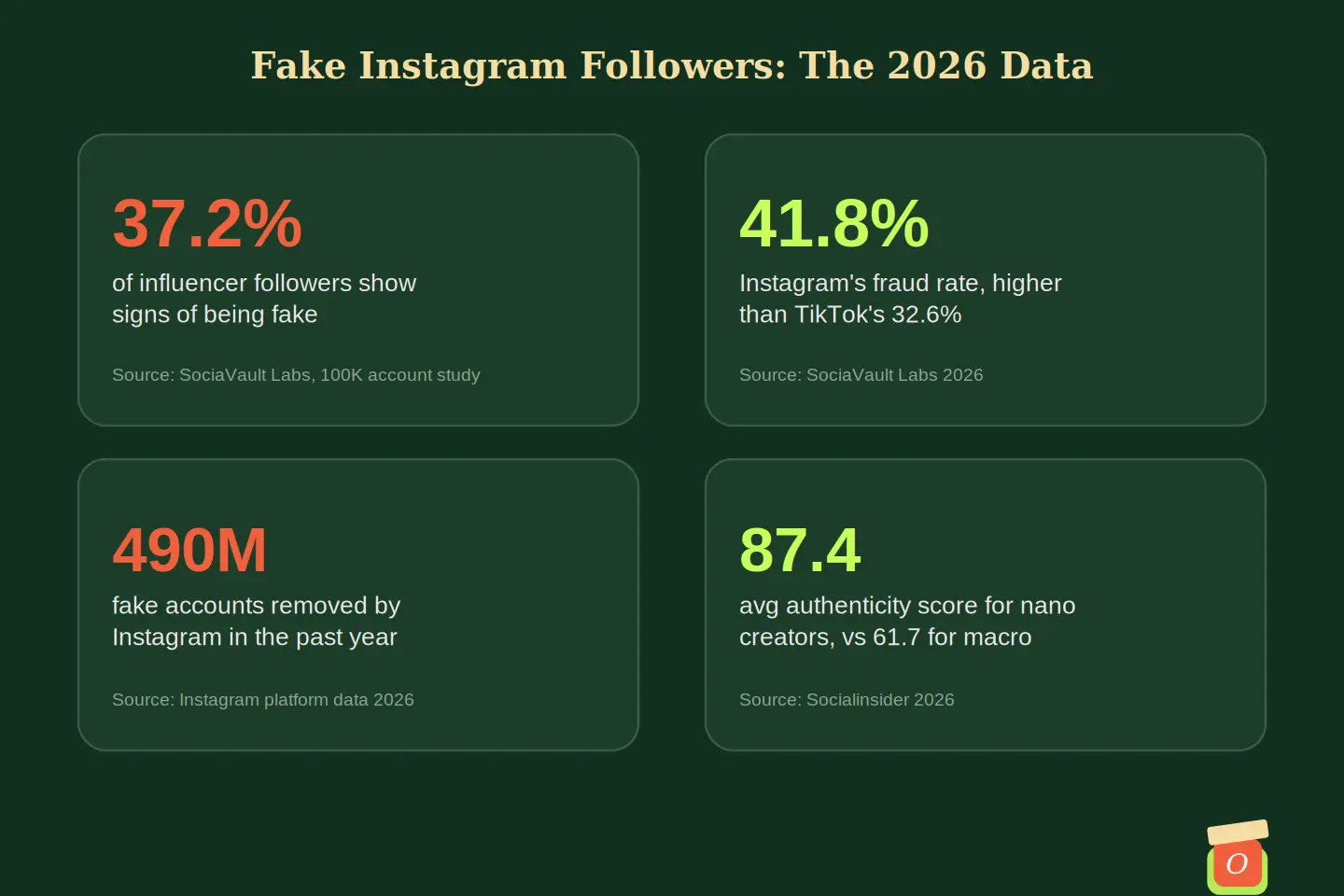
A 100,000-account study published in 2026 found that 37.2 percent of influencer followers show signs of being fake, purchased, or otherwise inauthentic. Instagram’s own fraud rate came in even higher at 41.8 percent, meaningfully above TikTok’s 32.6 percent in the same study. If more than a third of the audience you might be paying for is not real, learning how to spot fake Instagram followers is not optional homework. It is basic budget protection.
This guide breaks down exactly how to spot fake Instagram followers, from the different types of inauthentic accounts to the manual checks anyone can run in a few minutes, along with the creator tiers that carry the most risk. It also covers how a verified platform like Brand-O-fluence automates this detection so brands do not have to run every check manually. By the end, you will have a clear, repeatable process for catching fake followers before you pay for them, not after a campaign has already underdelivered. This builds directly on the fraud-detection steps covered in our broader guide on how to analyze Instagram influencers, going deeper into the fake follower problem specifically.
Table of Contents
- Why Fake Followers Are a Bigger Problem Than Most Brands Realize
- Types of Fake Instagram Followers You Should Know
- How to Spot Fake Instagram Followers Manually
- Advanced Signals: Growth Spikes and Engagement Pods
- Which Creator Tiers Carry the Most Fake Follower Risk
- How Brand-O-fluence Detects and Removes Fake Creators
- Step-by-Step Checklist: Spotting Fake Followers Before You Pay
- Frequently Asked Questions About How to Spot Fake Instagram Followers
Why Fake Followers Are a Bigger Problem Than Most Brands Realize
Fake followers rarely announce themselves. They hide inside an otherwise normal-looking profile, which is exactly why so many brands only discover the problem after a campaign has already underperformed and the budget is already spent.
How Common Are Fake Followers, Really?
The most methodologically transparent study available in 2026, an independent analysis of 100,000 Instagram and TikTok accounts, found that 37.2 percent of influencer followers showed meaningful signs of being fake or inauthentic. Instagram itself has stepped up enforcement too, removing an estimated 490 million fake accounts over the past year, though the sheer scale of the platform means plenty still slip through.
Why Fake Followers Are So Hard to Spot at a Glance
A profile with fake followers can still have a real photo, a believable bio, and genuine-looking posts, since the manipulation usually happens on the follower and engagement side rather than the account itself. Follower counts and post aesthetics say nothing about who is actually behind each follower, which is exactly the gap that fake follower detection is designed to close.
The Real Cost to Your Campaign Budget
Paying a creator based on an inflated follower count means paying for reach that partly does not exist, on top of losing the opportunity cost of a campaign that could have gone to a genuinely engaged creator instead. Fraud losses tied to fake followers and bot activity are estimated in the billions of dollars annually across the industry, and individual brands absorb a share of that every time they skip verification.
Types of Fake Instagram Followers You Should Know
Not all fake followers work the same way, and knowing the difference helps you recognize the specific patterns each type leaves behind. Some are fully automated, some are operated by real people paid to click and follow, and some are simply accounts that went quiet years ago.
- Bot accounts: Automated profiles with no real person behind them, often used to inflate follower counts in bulk.
- Purchased followers and click farms: Real but low-quality accounts, sometimes operated by workers paid to like and follow on demand, sold in bulk packages.
- Inactive and abandoned accounts: Genuine accounts created by real people who simply stopped using Instagram, still counted in follower totals but contributing nothing to engagement.
- Engagement pod participants: Real, active accounts that coordinate to like and comment on each other’s posts regardless of genuine interest in the content.
Bot Accounts
Bot accounts typically have generic usernames, little or no profile photo, few or no posts of their own, and follow an unusually large number of other accounts. They rarely comment, and when they do, the comments tend to be generic or completely unrelated to the post.
Purchased Followers and Click Farms
Click farm accounts are harder to spot than simple bots because real people operate them, often clicking and following on a paid, repetitive basis. These accounts may have some profile activity, but their engagement patterns rarely match genuine interest in any specific niche or brand.
Inactive and Abandoned Accounts
These accounts are not malicious, just dormant, which still quietly inflates a creator’s follower count without contributing any real engagement. A creator who gained a large following years ago in a different niche often carries a meaningful percentage of these inactive followers today.
How to Spot Fake Instagram Followers Manually
You do not need specialized software to catch the most obvious signs of fake followers. A structured manual review handles a surprising amount of the work.
Check the Follower-to-Following Ratio
A healthy creator profile usually has far more followers than accounts they follow. A profile following thousands of accounts while claiming a much larger follower count is a pattern worth investigating further, since it often correlates with follow-for-follow schemes used to inflate numbers artificially.
Look at Profile Completeness
Spot-check a sample of a creator’s followers by clicking into a handful of profiles directly. Missing profile photos, no bio, zero posts, and generic usernames with strings of random numbers are all classic signs of bot or low-quality accounts padding out a follower list.
Review Comment Patterns Across Posts
Genuine engagement includes specific, varied comments that reference the actual content of a post. Comment sections filled with generic phrases, repeated emoji, or the same small handful of accounts appearing under every single post are strong indicators of inauthentic engagement.
Advanced Signals: Growth Spikes and Engagement Pods
Once you have covered the basics, a few more advanced checks catch fraud that is specifically designed to look more convincing at first glance.
Reading a Follower Growth Chart
Organic follower growth tends to be gradual, with occasional bumps tied to viral content, press coverage, or collaborations. A sudden vertical jump in a growth chart, with no corresponding spike in engagement or public attention, is one of the clearest signals of a purchased follower batch.
Recognizing Engagement Pod Behavior
Engagement pods produce comments that arrive in a tight cluster shortly after a post goes live, often from the same rotating group of accounts across multiple unrelated creators. This pattern is harder to catch manually than a simple bot check, but repeated overlap between the same commenters across several different creators’ posts is a strong tell.
Cross-Checking Engagement Against Tier Benchmarks
Compare a creator’s engagement rate against the typical range for their specific follower tier rather than a flat industry average. A profile posting engagement far outside the normal range for its size, in either direction, deserves closer scrutiny before you commit budget.
Which Creator Tiers Carry the Most Fake Follower Risk
Fake follower risk is not evenly distributed across creator sizes. Knowing where the risk concentrates helps you decide where extra scrutiny matters most.
Why Mid-Tier Accounts Are the Riskiest
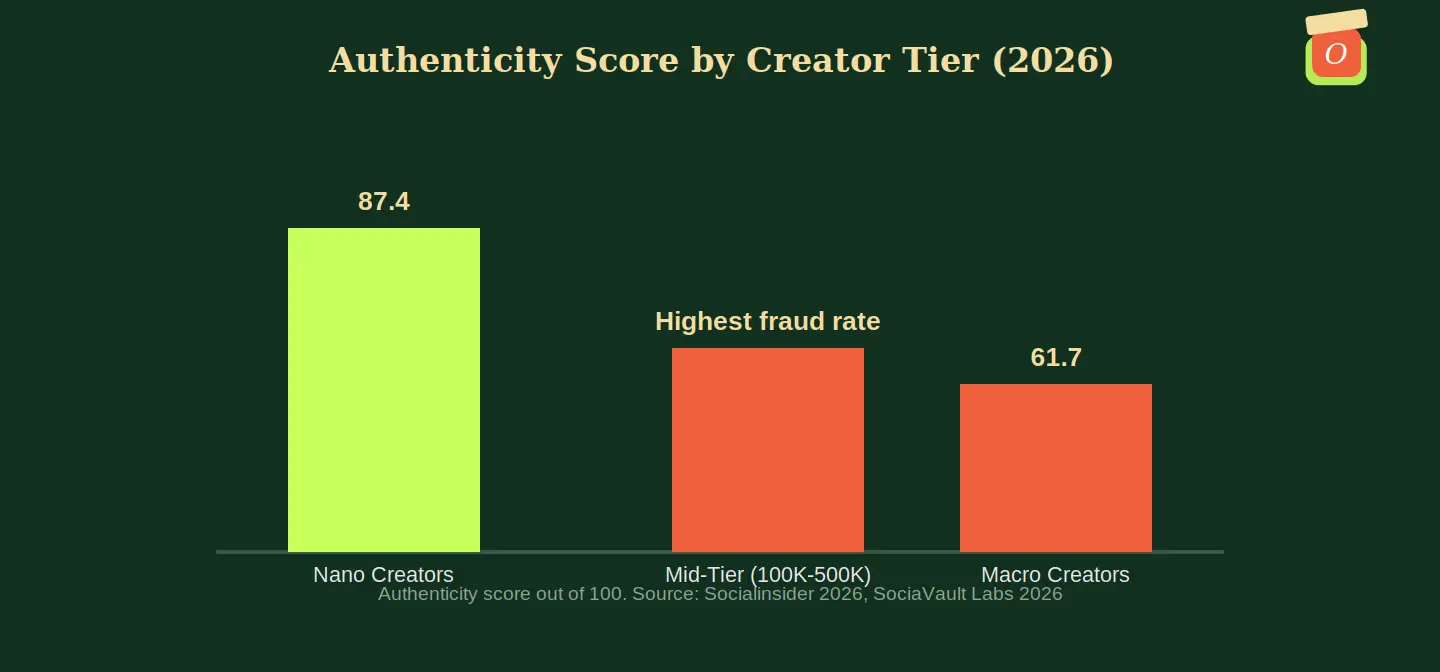
Creators in the 100,000 to 500,000 follower range showed the highest fraud rate of any tier in the 2026 SociaVault Labs study. This tier sits in an awkward middle ground, large enough to command solid rates but not always large enough to attract the same scrutiny that top-tier celebrity accounts receive.
Why Nano Creators Score Higher on Authenticity
Nano creators posted an average audience authenticity score of 87.4 out of 100 in a 2026 Socialinsider report, compared to just 61.7 for macro-tier creators. Smaller, more personal audiences are harder to fake convincingly, which is part of why nano and micro creators continue to gain ground in brand budgets.
What This Means for Your Budget
Extra verification matters most for the mid-tier and macro creators commanding the largest budgets, precisely because that is where the highest fraud rates and the biggest financial exposure overlap. A smaller creator with a lower rate carries less risk in absolute terms even before you factor in authenticity, which is one more reason a diversified mix of creator sizes often outperforms a single large placement.
How Brand-O-fluence Detects and Removes Fake Creators
Brand-O-fluence was built to take the fraud detection process covered in this guide and run it automatically, at scale, before a creator ever appears in a brand’s search results.
Automated Follower Spike Detection
Every profile on the platform is monitored for unusual follower growth patterns, flagging accounts with the kind of sudden, unexplained spikes covered earlier in this guide. This is the same verification standard discussed in our deeper look at why influencer analytics matter, where consistent, verifiable data replaces guesswork at every stage of a campaign.
Manual Review Before Any Profile Goes Live
Automated detection catches the obvious cases, but human reviewers check flagged profiles before they are approved, since some patterns, like engagement pod behavior, still benefit from a trained eye. This combination of automated screening and manual review is part of the broader evaluation process covered in our guide on how to choose the perfect influencer for your brand, where authenticity is one of several criteria brands should weigh before committing budget.
Ongoing Audits, Not One-Time Checks
Creator profiles are re-checked periodically rather than verified once and left alone indefinitely, since a genuinely authentic account today can still purchase followers or fall into an engagement pod later. This ongoing approach catches problems that a single point-in-time audit would miss entirely.
Consider a Delhi-based electronics brand that had shortlisted a mid-tier creator with an impressive 220,000 followers for a major product launch. Automated screening on Brand-O-fluence flagged an unexplained follower spike of nearly 40,000 accounts within a two-week window several months earlier, with no corresponding increase in engagement. A manual review confirmed the pattern matched a known purchased-follower batch, and the brand redirected its budget to two verified micro creators instead, avoiding a payment that would have been based on a significantly inflated audience.
Step-by-Step Checklist: Spotting Fake Followers Before You Pay
Run through this sequence before finalizing any creator partnership, regardless of how impressive their profile looks at first glance.
- Check the follower-to-following ratio: Flag profiles following an unusually high number of accounts relative to their own follower count.
- Spot-check a sample of followers: Click into 10 to 15 random followers and look for incomplete profiles or bot-like usernames.
- Review comments across multiple posts: Look for genuine, varied comments rather than generic or repeated replies.
- Check the follower growth chart: Look for sudden, unexplained spikes with no corresponding public moment.
- Compare engagement to tier benchmarks: Confirm the creator’s engagement rate falls within a normal range for their follower size.
- Cross-check overlapping commenters: Watch for the same small group of accounts appearing across multiple, unrelated creators’ posts.
- Use verified platform data when available: Confirm manual findings against a platform that pulls data directly from official sources.
Fake Follower Detection: Manual Check vs Verified Platform
The table below compares what each approach can realistically catch.
| Detection Method | Manual Check | Brand-O-fluence Verified Platform |
|---|---|---|
| Bot Account Detection | Possible with time-consuming spot checks | Automated across the full follower base |
| Growth Spike Monitoring | Requires manual chart review, if data is available at all | Continuous, automated monitoring |
| Engagement Pod Patterns | Difficult without cross-referencing many profiles | Flagged through pattern analysis and human review |
| Time Required | 15 to 30 minutes per creator | Instant, verified before a profile appears in search |
| Consistency Across Creators | Varies by reviewer | Standardized for every profile |
Frequently Asked Questions About How to Spot Fake Instagram Followers
What percentage of Instagram followers are typically fake?
A large 2026 study of 100,000 accounts found that 37.2 percent of influencer followers showed signs of being fake or inauthentic, with Instagram’s fraud rate at 41.8 percent specifically. The exact percentage varies significantly by creator tier and niche, so this figure should be treated as an industry average rather than a fixed number for every profile. Verification remains necessary on a case-by-case basis regardless of the overall average.
Can fake followers be completely eliminated from a creator’s account?
No creator has a perfectly clean follower list, since some inactive or bot accounts accumulate naturally over time even without any deliberate manipulation. The goal of fake follower detection is not zero fake followers, but confirming the overall percentage stays low enough that it does not meaningfully distort engagement and reach figures. A small percentage of inactive followers is normal and generally not a red flag on its own.
Is it possible to buy Instagram followers and hide it from brands?
It is more difficult than it used to be, since growth pattern analysis and audience authenticity scoring can now detect the sudden spikes and low-quality follower profiles typical of purchased growth. That said, sophisticated fraud, particularly slow, gradual purchases designed to mimic organic growth, can still slip past a quick manual check. This is exactly why layered detection, combining manual review with verified platform data, works better than either approach alone.
Do fake followers only affect follower count, or engagement too?
Fake followers affect both, since inactive and bot accounts inflate the denominator used to calculate engagement rate while contributing little or no genuine interaction. This means a creator with a significant percentage of fake followers often shows an artificially depressed engagement rate, on top of an inflated audience size. Both numbers need to be checked together for an accurate picture.
Should I avoid mid-tier creators entirely because of higher fraud rates?
Not necessarily, since plenty of mid-tier creators maintain genuinely authentic audiences despite the tier’s higher average fraud rate. The data simply suggests this tier deserves extra scrutiny before committing a larger budget, rather than being avoided outright. A verified, individual check on the specific creator matters more than the general risk level of their follower tier.
Knowing how to spot fake Instagram followers protects your campaign budget from one of the most common and costly problems in influencer marketing today. Manual checks like follower ratios, comment quality, and growth chart patterns catch a meaningful share of obvious fraud, while more advanced signals like engagement pod behavior and tier-specific benchmarks catch what a quick glance would miss. Brands that build this checking into every partnership consistently spend their budget on audiences that actually exist, rather than discovering the gap only after a campaign has already run its course.
If you want fake follower detection handled automatically, explore Brand-O-fluence today. Every creator profile is screened through automated spike detection and manual review before it ever appears in search results, so you can skip the guesswork entirely. Start working with verified creators on Brand-O-fluence instead of hoping a follower count tells the whole story.
Leave a Reply