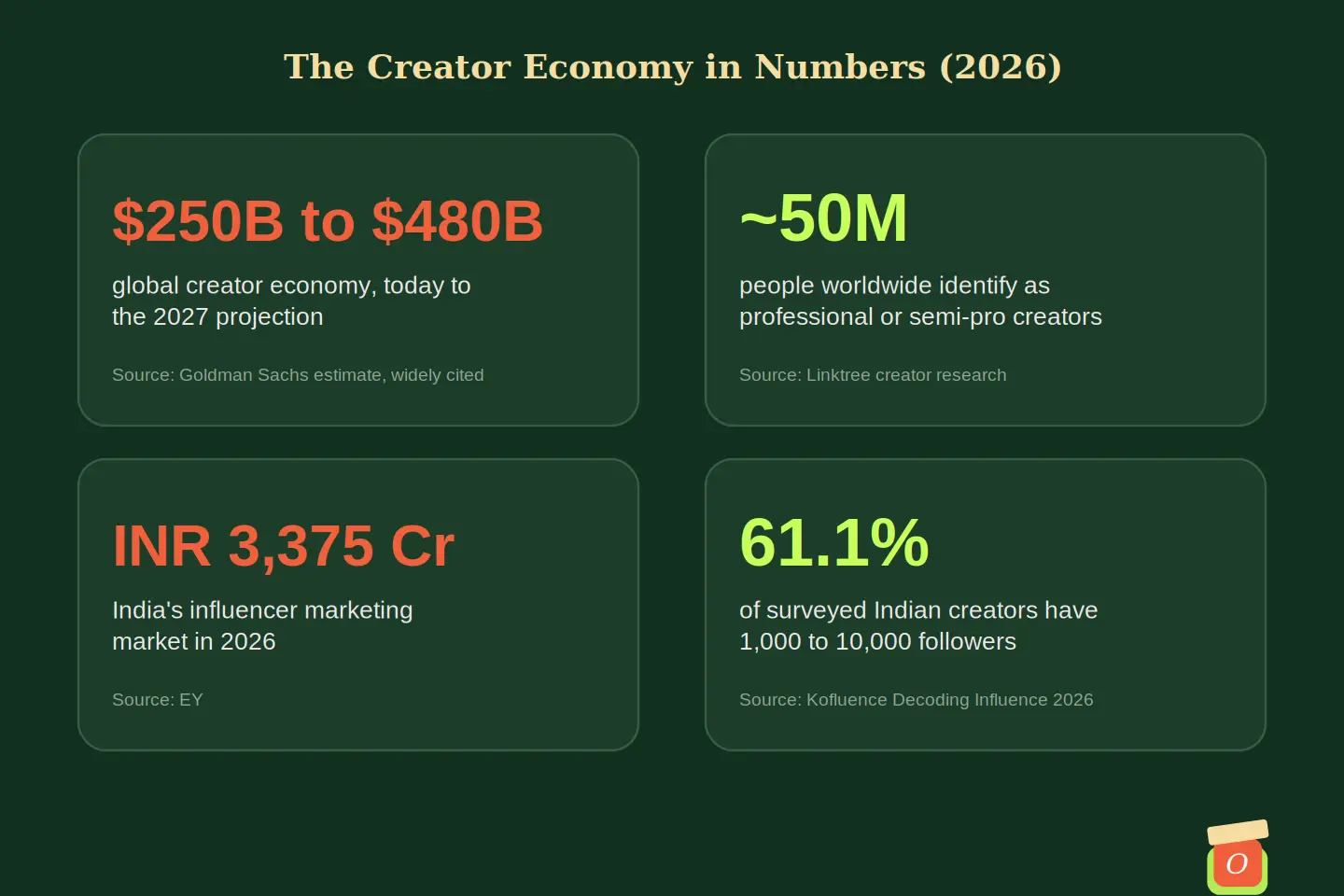
Goldman Sachs estimated the global creator economy at roughly $250 billion and projected it to reach $480 billion by 2027. In India, the influencer marketing market alone is tracking toward INR 3,375 crore in 2026, according to EY. Yet ask ten marketers what is the creator economy, and you will get ten different answers, from “influencers posting ads” to “a new kind of media industry.” The truth sits somewhere in between, and understanding it changes how brands plan budgets and how creators plan careers.
This guide gives you a plain-English answer to what is the creator economy, shows how big it really is (and why the numbers vary so much), breaks it into six building blocks, and explains where the system still breaks down. It also shows how Brand-O-fluence acts as infrastructure for the whole loop: verified creators, campaigns, payments, and analytics in one place. If you want the India-specific picture, our guide on the future of influencer marketing in India is a good companion read.
Table of Contents
- What Is the Creator Economy? A Plain-English Definition
- How Big Is the Creator Economy in 2026?
- The Six Building Blocks of the Creator Economy
- How Creators Make Money
- The Problems Holding the Creator Economy Back
- How Brand-O-fluence Powers the Creator Economy
- What Comes Next for the Creator Economy
- Step-by-Step: How Brands and Creators Can Get Started
- Frequently Asked Questions About What Is the Creator Economy
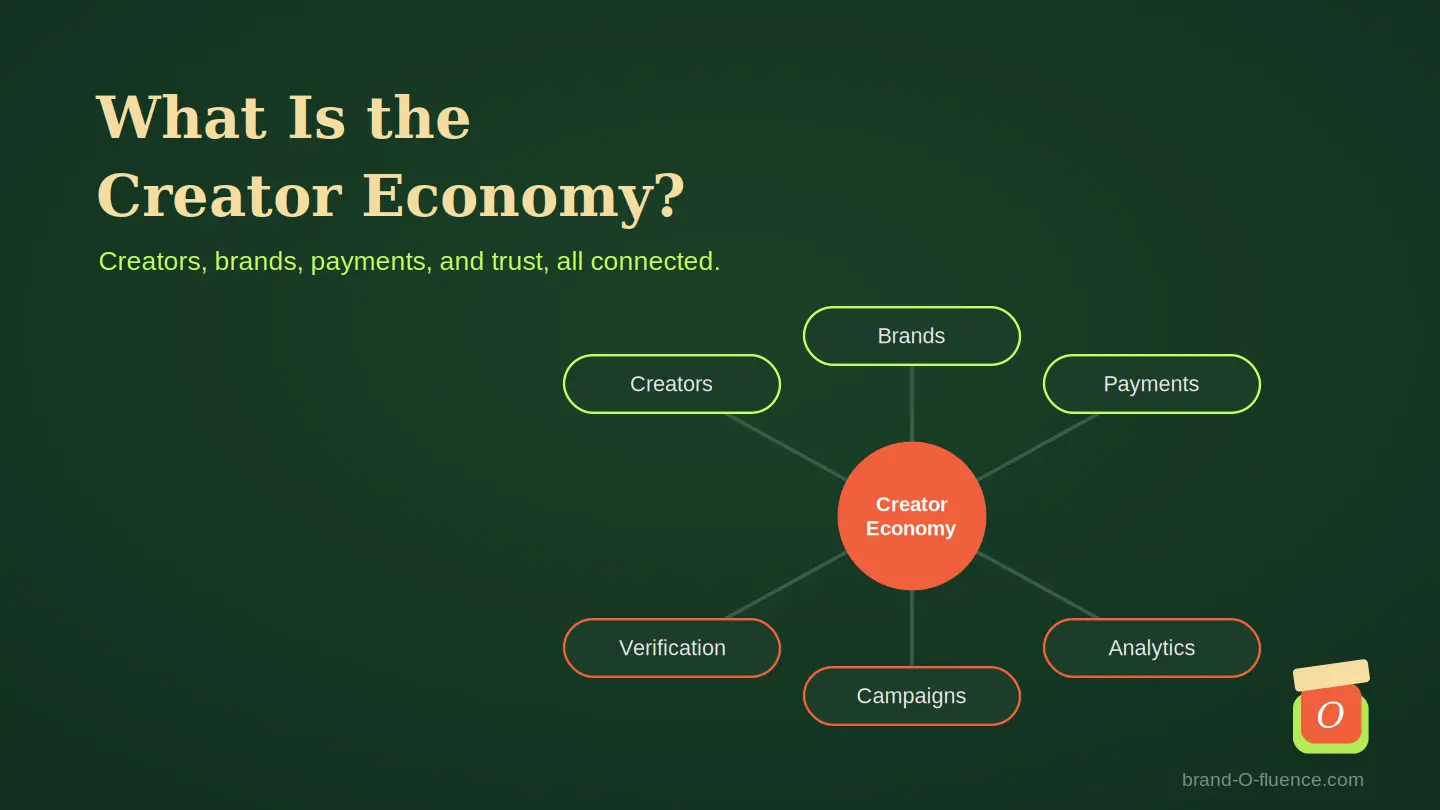
What Is the Creator Economy? A Plain-English Definition
The creator economy is the system of people who make content online, the audiences who follow them, and the businesses that pay to reach those audiences. It includes the tools creators use, the platforms that host their work, and the money that moves between everyone involved.
Who Is Inside It
At the center are creators: video makers, writers, photographers, podcasters, educators, and everyday people who built an audience around a skill or interest. Around them sit platforms, brands, agencies, payment providers, and software tools. Each group depends on the others, which is why the creator economy works more like an ecosystem than a single industry.
How It Differs From Influencer Marketing
Influencer marketing is one part of the creator economy: brands paying creators to promote products. The creator economy is wider. It also covers ad revenue shared by platforms, fan subscriptions, digital products, courses, and live events. For brands, influencer marketing is the main doorway into this larger system.
Why It Matters to Brands
Audiences now spend large amounts of attention on creator content, and many trust it more than traditional advertising. A brand that understands how this ecosystem works can reach customers more cheaply and more credibly. A brand that treats creators as a quick ad channel often ends up with weaker results and strained relationships. Creators notice when a brand only shows up for a single post, and the best ones tend to prioritize partners who treat them as collaborators.
How Big Is the Creator Economy in 2026?
Size depends on who is counting and what they include. Estimates vary widely, so it helps to know why before you quote any number.
The Global Picture
Goldman Sachs’ widely cited estimate puts the creator economy at about $250 billion today, growing to $480 billion by 2027. Other 2026 compilations land in a different range, from roughly $216 billion to $313 billion, depending on what they count. Linktree research suggests about 50 million people worldwide see themselves as professional or semi-professional creators.
The India Picture
EY puts India’s influencer marketing market at INR 3,375 crore in 2026. One market report values the wider Indian creator economy at about USD 15 billion, while another gives a far lower figure, so treat any single number with caution. Creator counts vary just as much. BCG counts roughly 2 to 2.5 million creators who monetize, Kofluence reports 4.0 to 4.4 million active creators, and some estimates reach tens of millions when they include every person who posts regularly.
Why the Numbers Disagree
Some reports count only people who earn money from content, while others count anyone who posts. Some include equipment sales and software, while others measure only brand spending. When you read a headline number, check the definition behind it. For planning, the most useful facts are the proportions: in Kofluence’s 2026 survey, 61.1 percent of Indian creators had 1,000 to 10,000 followers, and only about 15 percent were registered as a business or GST individual.
The Six Building Blocks of the Creator Economy
Every creator partnership, large or small, depends on six building blocks. When one is weak, the whole chain suffers.
The Supply Side: Creators and Brands
Creators supply attention, trust, and content. Brands supply budgets, products, and briefs. Matching the right creator to the right brand is the first challenge, and it is why discovery tools and verified profiles matter so much. Our guide on how to choose the perfect influencer for your brand shows how to judge that fit.
The Trust Layer: Verification and Analytics
Brands need proof that a creator is real, that the audience is genuine, and that results are measurable. Verification confirms identity and audience quality, while analytics show what a campaign actually delivered. Without this layer, every deal is a gamble. With it, a brand can compare creators fairly, a creator can prove their value, and both sides can make decisions based on evidence rather than reputation or guesswork.
The Money Layer: Payments and Campaign Management
Briefs, contracts, content review, and payment make up the workflow that turns an agreement into published work. When these steps live in scattered emails and bank transfers, delays and disputes follow. Our guide on why escrow is important in influencer marketing explains how secure payments keep both sides protected.
How Creators Make Money
Creators earn through several routes, and most combine more than one. Knowing them helps brands understand what a creator needs from a partnership.
- Brand partnerships: Paid posts, Reels, Stories, and videos for sponsors, usually the largest income source for small and mid-size creators.
- Platform payouts: Ad revenue sharing, bonuses, and creator funds paid by the platforms themselves.
- Affiliate and commerce: Commission on sales through tracked links, codes, and shoppable posts.
- Direct fan revenue: Subscriptions, memberships, tips, and paid communities.
- Digital products and services: Courses, presets, templates, consulting, and live events.
Why Brand Deals Matter Most for Smaller Creators
Platform payouts usually require large audiences, and fan subscriptions take time to build. For a creator with 5,000 to 50,000 followers, a brand deal is often the first realistic way to earn. That is why fair rates and reliable payment matter so much to this group.
Why Few Creators Earn a Full Living
BCG estimates that only 8 to 10 percent of creators in India monetize effectively, and other surveys suggest that fewer than five percent earn their main income from content. The reasons are practical: inconsistent brand demand, slow payments, and difficulty proving value to buyers. Fixing those problems is the biggest opportunity in the whole system, because every creator who earns reliably produces more and better content for brands to work with.
What This Means for Brands
Brands that pay promptly, brief clearly, and rebook good creators tend to get better content and better rates. Creators talk to each other, and a brand’s payment record travels fast. Treating creators as long-term partners is both fairer and more profitable, since repeat relationships need less negotiation and produce better content each time.
The Problems Holding the Creator Economy Back
The creator economy has grown quickly, but its infrastructure has not kept pace. Four problems come up again and again.
Fraud and Trust Gaps
A 2026 study of 100,000 accounts found that 37.2 percent of influencer followers showed signs of being fake or inauthentic. Brands that cannot verify audiences end up paying for reach that does not exist. Our guide on how brands can avoid fake influencers covers the process that prevents this.
Late and Unsafe Payments
Industry research reports that about 42 percent of micro-influencers have faced payment delays or non-payment. Brands, meanwhile, worry about paying for content that never arrives. Neither side can build a long-term relationship on that foundation. A creator who has been paid late once will often quote higher or decline the next offer, and a brand that has been burned once may cut its creator budget altogether.
Fragmented Tools
A typical campaign may involve a spreadsheet for shortlists, DMs for negotiation, email for contracts, a bank app for payment, and screenshots for reporting. Every handoff creates room for error. Brands and creators both lose time that should go into making and measuring content. Small teams feel this most, since one missed email can delay a launch by days.
Weak Measurement
Many campaigns are judged on screenshots rather than verified data, which makes it hard to compare creators fairly or learn from results. Without reliable numbers, brands cannot tell which partnerships deserve more budget.
How Brand-O-fluence Powers the Creator Economy
Brand-O-fluence is built as infrastructure for the six building blocks, so brands and creators do not have to stitch together separate tools. Each block maps to a feature.
Verified Creators and Brands in One Marketplace
Creators are verified for identity, account ownership, and audience quality before they appear in search. Brands can filter by niche, city, platform, and follower range, from 5K nano creators to larger names. This closes the trust gap at the start of every partnership.
Campaigns, Payments, and Analytics in One Workflow
Briefs, contracts, content review, escrow-protected payments, and verified analytics run in the same platform. Creators get paid when verified work is delivered, and brands pay only for what arrives. The process follows the stages in our guide on how to run an influencer campaign.
Opportunity for Smaller Creators
Because the platform supports small follower ranges, creators with 5,000 or 10,000 followers can receive verified, paid collaborations that were once reserved for celebrities. This matches the data showing that nano and micro creators deliver strong returns, as covered in our guide on how nano creators beat celebrity influencers.
Consider a food creator in Bhopal with 9,000 followers who had never received a paid brand deal. After creating a verified profile, she was matched with a Kochi-based snack brand looking for Hindi-language creators in Madhya Pradesh. The brand funded escrow before she filmed, she delivered two Reels and a Story set, and payment released once the content was confirmed live. The brand rebooked her for the next campaign, and she has since added two more brand partners.
What Comes Next for the Creator Economy
Three trends are shaping the next phase, and each rewards brands and creators who prepare early.
Formalization
More creators are registering as businesses, issuing invoices, and handling tax properly. Brands will increasingly expect clean paperwork, which favors platforms that handle invoicing and compliance. Creators who formalize early will find it easier to win larger and more regular deals.
AI in the Workflow
AI already helps with creator matching, caption drafts, and scheduling. Human judgment still matters for verification and creative decisions, which is why the best systems combine both.
Regional and Vernacular Growth
Creators in smaller cities and regional languages are among the fastest-growing groups. Brands that learn to work with them early will reach customers their competitors overlook. A creator in Nagpur or Guwahati speaking the local language often understands buyers better than a national name ever could.
Step-by-Step: How Brands and Creators Can Get Started
Whether you are a brand or a creator, these steps help you join the creator economy on solid footing.
- Define your goal: Brands choose awareness, engagement, or sales. Creators decide which kind of partnership they want.
- Create a verified profile or shortlist: Creators complete verification. Brands filter for verified creators by niche, city, and follower range.
- Agree on clear deliverables: Put format, deadline, usage rights, and payment terms in writing.
- Use escrow for payment: Fund the deal before work starts and release it when content is verified.
- Review content against the brief: Give specific feedback and confirm disclosure requirements.
- Measure verified results: Use real analytics, not screenshots.
- Build long-term relationships: Rebook the partners who deliver and pay promptly.
The Building Blocks and the Problems They Solve
The table below links each building block to the common problem it addresses and how Brand-O-fluence handles it.
| Building Block | Common Problem | How Brand-O-fluence Helps |
|---|---|---|
| Creators | Hard to find paid work, especially for small creators | Verified profiles and AI-assisted matching |
| Brands | Slow, manual creator search | Filters by niche, city, platform, and follower range |
| Payments | Late payment and paying for undelivered work | Escrow-protected release on verified delivery |
| Verification | Fake followers and impersonation | Identity, ownership, and audience checks with human review |
| Campaigns | Scattered DMs, emails, and spreadsheets | One workflow from brief to completion |
| Analytics | Results judged by screenshots | Verified engagement and audience data |
Frequently Asked Questions About What Is the Creator Economy
What is the creator economy in simple terms?
The creator economy is the system of people who make online content, the audiences who follow them, and the businesses and platforms that pay to reach those audiences. It covers brand deals, platform payouts, fan subscriptions, and digital products. Influencer marketing is one part of it.
How big is the creator economy?
Estimates vary by definition. Goldman Sachs’ widely cited figure is about $250 billion, projected to reach $480 billion by 2027, while other 2026 reports give figures from about $216 billion to $313 billion. Always check what a report counts before using its number.
How many creators are there in India?
Counts range widely. BCG estimates 2 to 2.5 million monetizing creators, Kofluence reports 4.0 to 4.4 million active creators, and broader estimates run into tens of millions. The difference comes from whether a report counts only earners or everyone who posts regularly.
How do creators make money?
Most combine brand partnerships, platform payouts, affiliate commissions, fan subscriptions, and digital products. For smaller creators, brand deals are usually the first and largest source of income. Reliable payment and fair rates matter more to them than anything else.
Why do brands need verified creators?
Fake followers and impersonation are common, with one 2026 study finding that 37.2 percent of influencer followers showed signs of being inauthentic. Verification confirms that a creator is real and that their audience is genuine. It protects your budget and improves your results. It also saves time, since you spend less effort checking profiles by hand and more effort planning the campaign itself.
What is the creator economy? It is the connected system of creators, audiences, brands, platforms, and payments that now shapes how products get discovered and trusted. It is large, fast-growing, and still held back by fraud, late payments, scattered tools, and weak measurement. Brands and creators who build on verified, well-structured foundations will capture most of the value as the system matures.
If you want to take part with less risk, explore Brand-O-fluence today. Find verified creators by niche and city, run campaigns in one workflow, pay safely through escrow, and track results with real analytics. Join Brand-O-fluence as a brand or a creator and start building in the creator economy on solid ground. Whether you are running your first campaign or your fiftieth, the same verified foundation applies every time.
Leave a Reply